Free NAPLEX Mock Exam 2: Test Your Clinical Reasoning and Calculations
Most candidates reach a point in NAPLEX preparation where the material starts to feel familiar. You recognize the drug classes. You have read the guidelines more than once. The pages stop surprising you.
Familiarity is not the same as retrieval.
The NAPLEX does not ask whether you have seen a topic before. It asks whether you can pull the right information out of memory, apply it to one specific patient, and commit to a decision — usually while a clock is running, and often in questions that require you to apply several pieces of information at once.
That gap between recognizing content and using it is where preparation quietly stalls. Reading more rarely closes it. The only dependable way to measure it is to sit a complete mixed assessment you have never seen before.
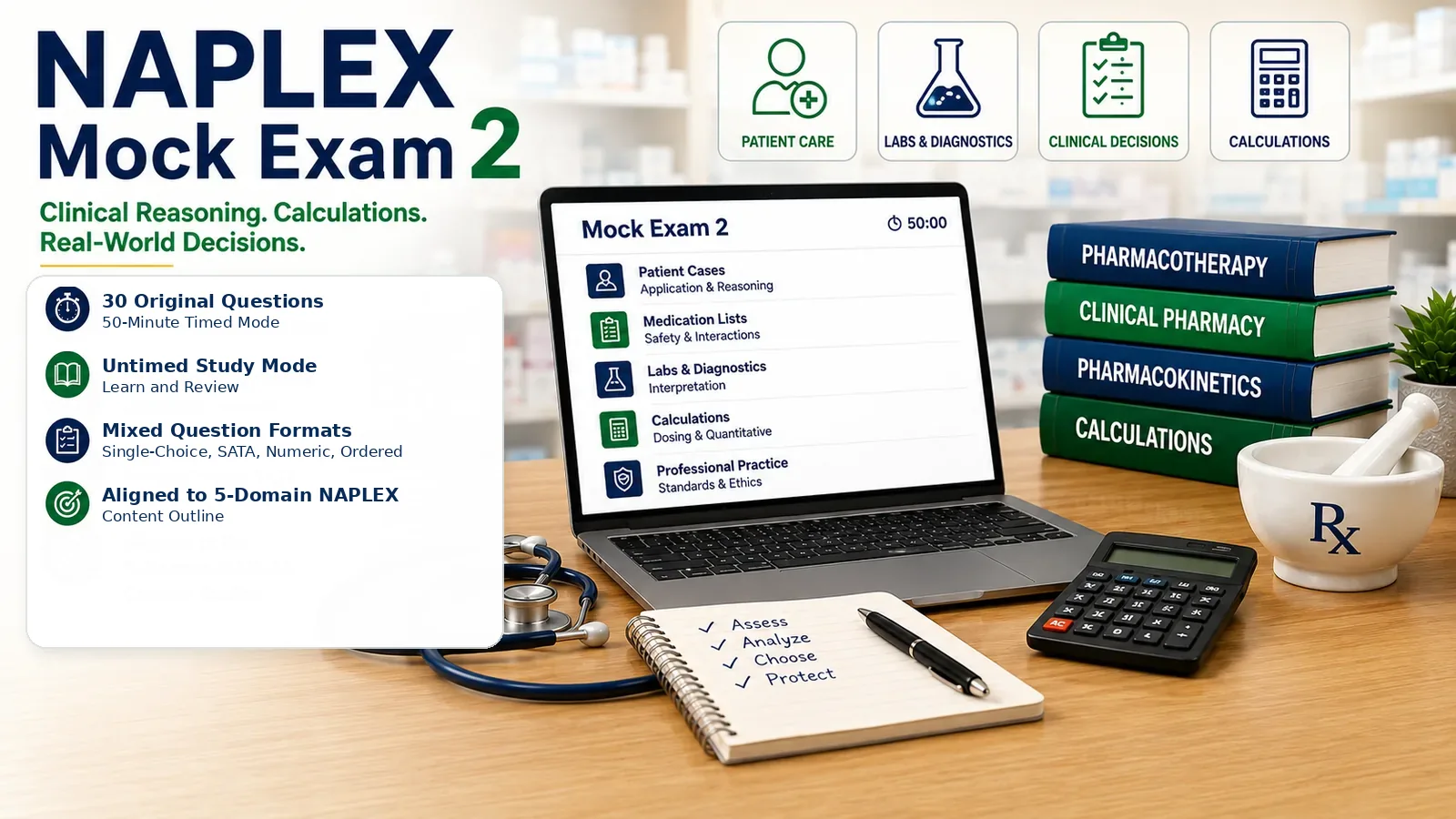
Free NAPLEX Mock Exam 2 exists for exactly that. It is a second, fully independent 30-question checkpoint built around the current NAPLEX content outline. It is not a rerun of Mock Exam 1 and not a topic quiz. It is designed to be taken after you have already done some targeted study, so that it can tell you whether that work actually changed your performance.
What Is Free NAPLEX Mock Exam 2?
Mock Exam 2 is a free, 30-question practice examination written specifically for pharmacy graduates preparing for the United States NAPLEX. Every question is original to RxBoardPrep and every question is new — none of them appear in Mock Exam 1.
Mock Exam 2 at a glance
- 30 original questions, none shared with Mock Exam 1
- 50-minute Timed mode for realistic pacing
- Untimed Study mode for learning and remediation
- Written against the current five-domain NAPLEX content outline
- Mixed formats: single-choice, select-all-that-apply, numeric entry, ordered response
- Free to use, with no account required
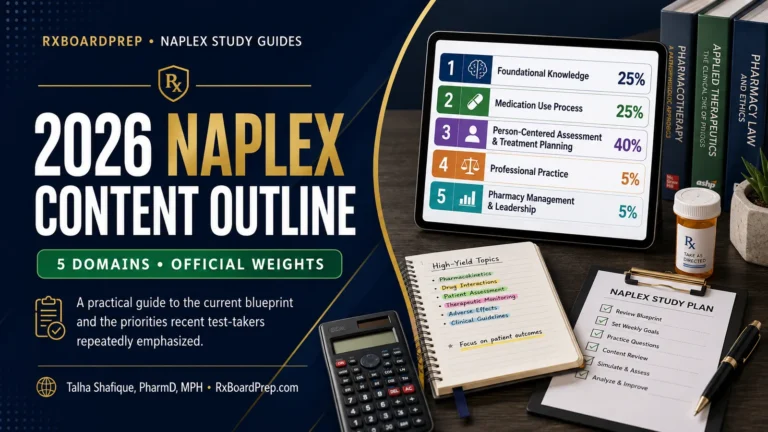
The blueprint alignment matters more than it might sound. The National Association of Boards of Pharmacy restructured the NAPLEX content outline effective May 1, 2025, replacing the older competency areas with five domains and new weights:
| Domain | Approximate weight |
|---|---|
| 1 — Foundational Knowledge for Pharmacy Practice | 25% |
| 2 — Medication Use Process | 25% |
| 3 — Person-Centered Assessment and Treatment Planning | 40% |
| 4 — Professional Practice | 5% |
| 5 — Pharmacy Management and Leadership | 5% |
Mock Exam 2 was written against that structure, which means the heaviest concentration of questions sits in person-centered assessment and treatment planning — the same place the official outline puts its weight. If you have not yet read through the outline itself, the 2026 NAPLEX content outline explained walks through all five domains and what each one covers.
One thing to be clear about from the start: this is an independent educational practice exam. It is not an official NABP examination, it is not a retired NAPLEX form, and it does not reproduce real test items.
Why Take a Second NAPLEX Mock Exam?
The most common mistake with practice exams is treating them as a score to collect rather than a signal to act on. A candidate takes a mock, sees 62%, reviews the answers for an hour, and retakes the same mock a week later. The score climbs to 84% and the candidate feels ready.
Very little of that improvement is real. Retaking questions you have already reviewed measures recognition memory, not clinical reasoning. You remember that the answer involved the ACE inhibitor; you do not necessarily remember why, and you have not proven you would reach the same conclusion on a patient you have never met.
A mock exam is most diagnostic the first time you see the questions. After review, retaking it becomes a learning exercise rather than a clean independent checkpoint.
A second independent exam solves this. It gives you a clean reading on unfamiliar material, which is the only way to answer the question that actually matters: did the studying I did between the two attempts change how I perform?
That is why Mock Exam 1 and Mock Exam 2 should not be taken back to back. The sequence that produces useful information looks like this:
- Mock Exam 1 — establishes a baseline and exposes weaknesses
- A focused repair block — study aimed squarely at those specific weaknesses
- Mock Exam 2 — tests whether the repair held on new material
Taken that way, the two exams function as bookends around a study block rather than as two scores in a row.
Ready for your second checkpoint?
Mock Exam 2 takes 50 minutes in Timed mode and gives you a full answer review afterward. Take it in one uninterrupted sitting for the cleanest result.
Not ready for Mock 2 yet? Start with Free NAPLEX Mock Exam 1.
What Mock Exam 2 Is Designed to Test
Mock Exam 2 emphasizes application and decision-making while still testing the foundational knowledge needed to make those decisions. Five skills carry most of the exam.
Clinical reasoning
Most of the exam sits here, matching the weight the content outline gives to person-centered assessment and treatment planning. These questions give you a patient and ask you to decide something: whether a therapy is appropriate, what should change, what should be monitored, what is unsafe as written. What makes them difficult is rarely the pharmacology — it is that the correct answer depends on patient-specific factors you have to notice first. The same drug can be appropriate for one patient and contraindicated for the next, and nothing in the question will flag which situation you are in.
Calculations and quantitative reasoning
Eight of the 30 questions involve quantitative or calculation reasoning, spanning patient-specific dosing, pharmacokinetic reasoning, compounding and concentration problems, biostatistics, medication-use calculations, and interpretation of quantitative clinical data. Four of those eight require you to type a numeric answer rather than choose one.
That distinction is deliberate. Multiple-choice calculations let you work backward from plausible answers. Numeric entry does not. If your setup is wrong, nothing catches you.
Medication lists and laboratory data
Several questions present a full medication list alongside laboratory values and vital signs. The skill being tested is triage: finding the data points that change the decision and setting aside the rest. That is different from knowing normal ranges — a candidate can recite every reference value and still miss the question because they did not connect a creatinine of 2.1 to the dose of the drug three lines above it.
Medication safety and monitoring
These questions ask what could go wrong and how you would detect it: clinically significant interactions, duplicate therapy, cumulative organ toxicity, contraindications created by a comorbidity, and the monitoring parameters that would catch a problem before it becomes harm.
Professional practice and pharmacy operations
A small number of questions cover professional responsibilities, documentation and communication, and the operational and leadership side of practice. Those two domains carry about five percent each on the official outline, and Mock Exam 2 keeps them proportionally light — so do not over-prepare them at the expense of clinical decision-making.
Question Formats You Will Encounter
Mock Exam 2 uses four response formats. Each one rewards a slightly different approach.
| Format | Count | What changes about your strategy |
|---|---|---|
| Single choice | 21 | One answer is best, not merely acceptable. Eliminate on safety and appropriateness before comparing the survivors. |
| Select all that apply | 4 | Judge each option independently as true or false. Do not aim for a number of selections, and do not add an option because the list looks short. |
| Numeric entry | 4 | No options to reason against. Write the setup out, track units through every step, and check the magnitude before committing. |
| Ordered response | 1 | Sequence matters. Decide the first and last steps first, then place the middle. |
This mix is RxBoardPrep’s practice design, built to give you exposure to each response type in one sitting. It does not represent the format distribution of the actual NAPLEX, which NABP does not publish at this level of detail.
The Detailed Patient Cases Matter
About two thirds of Mock Exam 2 is case-based or application-based, and three of those cases are substantial patient profiles containing multiple diagnoses, a full medication list, renal and hepatic information, laboratory results, and vital signs.
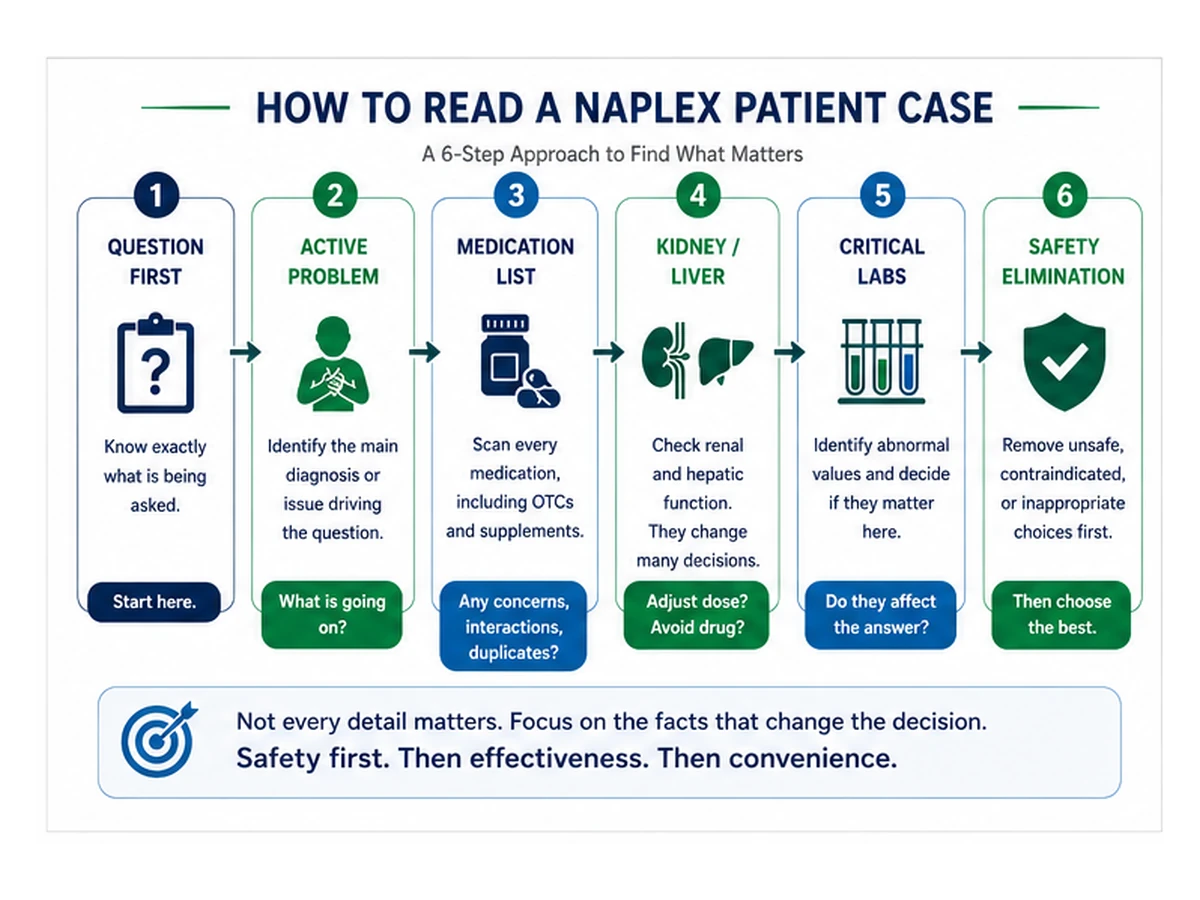
Long cases intimidate people, usually because of a misreading of what the extra detail is for. Candidates assume that if a number was included, it must matter, so they try to account for every value and run out of time. But real patients do not come pre-filtered either. Part of what a case question tests is whether you can tell decisive information from background — and some of the data in a well-written case is there precisely because a competent pharmacist would look at it and move on.
A reliable way through a long case is to read it in a fixed order every time:
- Read the actual question first. Know what is being asked before you read the case, so you read the case looking for something.
- Identify the active problem. What is the clinical issue this question turns on? A patient may have six diagnoses and only one of them is in play.
- Scan the medication list. Look for duplicates, therapy that does not match a listed diagnosis, and drugs that interact with each other.
- Check kidney and liver function. Kidney and liver function frequently change dosing, drug selection, or monitoring.
- Identify abnormal values, then ask whether they matter here. Note what is out of range — potassium, INR, glucose, a rising creatinine, an abnormal vital sign — then ask whether it actually affects the decision being tested. Not every abnormal value is the clue.
- Eliminate on safety first. Remove any option that is contraindicated or unsafe for this patient before deciding which of the rest is most appropriate.
Used consistently, this reduces a dense patient profile to a handful of decisive facts, and it does it in a predictable amount of time.
Timed Mode vs Study Mode
Mock Exam 2 can be taken either way. Both modes are useful; they simply answer different questions.
| Timed mode | Study mode | |
|---|---|---|
| Clock | 50 minutes, counting down | None |
| Best used for | Assessing readiness under realistic pressure | Learning and remediation |
| References | None — no notes, no lookups | Reasonable to think slowly and work things out |
| What it tells you | Whether you can perform, not just whether you know | Where your reasoning breaks down and why |
| When to choose it | Your first attempt, and any readiness check near the exam | Mid-preparation, or revisiting a weak area |
For a first attempt, use Timed mode: a readiness check is only meaningful if the conditions resemble the exam. Study mode is genuinely diagnostic too, it just diagnoses something different — working slowly through a question shows you exactly where your reasoning breaks down, which is what you need when repairing a weak area rather than testing yourself.
How to Pace 30 Questions in 50 Minutes
Fifty minutes across thirty questions averages about one minute and forty seconds each. That average is a planning tool, not a rule — and treating it as a rule is itself a pacing mistake.
The questions are not equally demanding. A recognition item might take forty seconds; a numeric-entry calculation inside a patient profile might reasonably take three and a half minutes. Finish the quick ones efficiently so the difficult ones have room.
| Checkpoint | Target elapsed time |
|---|---|
| Question 10 complete | ~16–17 minutes |
| Question 20 complete | ~33–34 minutes |
| Question 30 complete | ~50 minutes |
Checking around questions 10 and 20 is usually enough to tell whether your pacing is on track without constantly watching the clock.
If you are behind at question 20, the fix is to stop re-reading — most lost time goes into second-guessing questions you have already reasoned through, not into the hard ones. If a question has genuinely defeated you, mark your best available answer and move on. That is a decision about one question, not permission to start rushing; guessing through the last ten items to beat the clock produces a score that tells you nothing.
Before You Start Mock Exam 2
A few minutes of setup protects the quality of the result.
- Have a calculator ready and within reach.
- Find a quiet environment where you will not be interrupted for the full hour.
- Keep scratch paper available for calculation setups.
- Close your notes and study materials if you are using Timed mode.
- Commit to finishing in one sitting. A mock split across two evenings measures neither knowledge nor stamina.
- Decide in advance what you want this attempt to tell you.
One thing worth avoiding: last-minute review immediately before you start. It can temporarily inflate recall and make the diagnostic less clean. Go in cold.
How to Use Mock Exam 1 and Mock Exam 2 Together
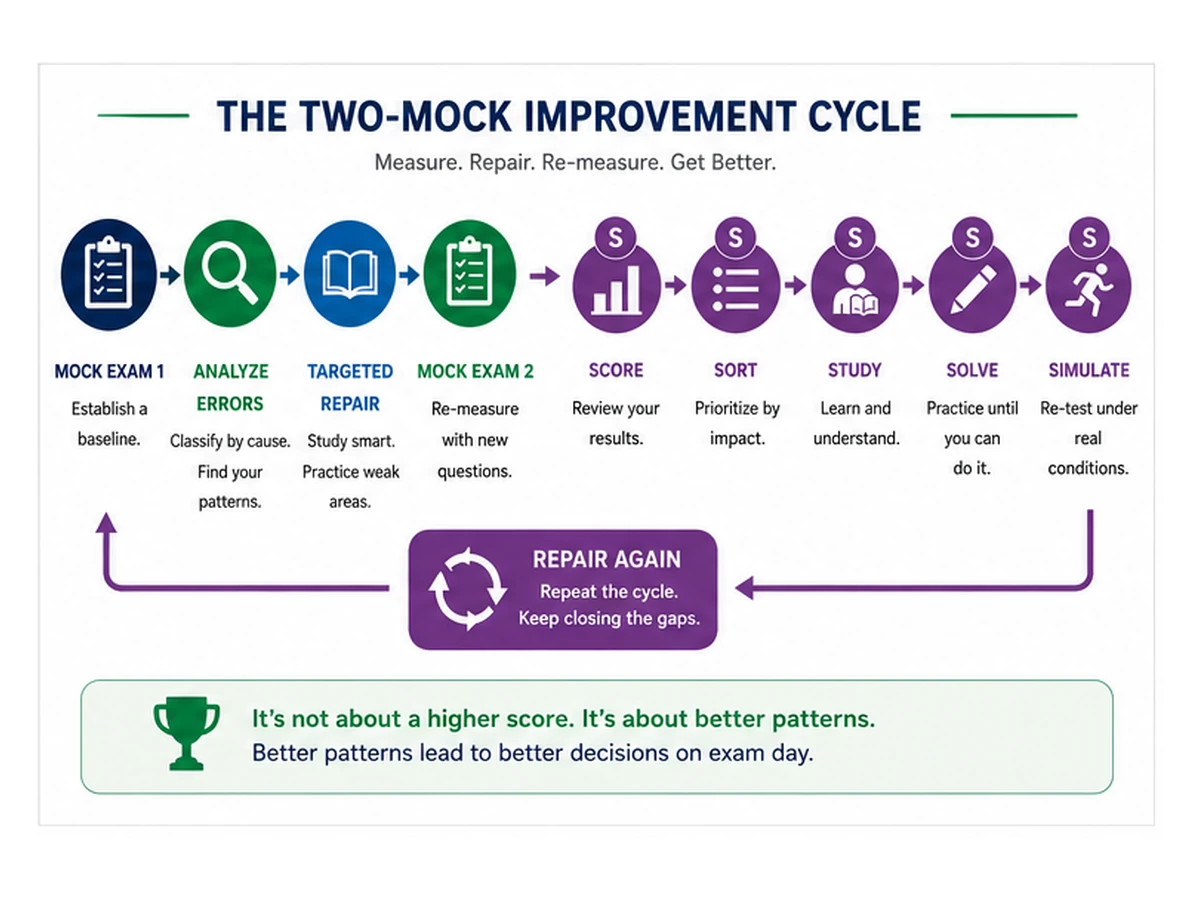
The two exams are most valuable as a matched pair separated by real study. Here is the full sequence.
Step 1 — Take Mock Exam 1
Sit Free NAPLEX Mock Exam 1 in Timed mode, under the conditions described above. This is your baseline.
Step 2 — Classify what went wrong
This step does the real work, and everything later in this article refers back to it. Go through every item you missed and every item you guessed correctly — a lucky guess is an unidentified weakness. Label each one with a cause:
- Knowledge gap — you did not know the underlying fact or relationship
- Misread — you knew it, but missed what the question or case actually asked
- Calculation setup — the equation or approach was wrong from the start
- Arithmetic — the setup was right and the execution slipped
- Timing — you ran short and answered without finishing your reasoning
- Clinical prioritization — you identified the right issues but ranked them wrongly
Keep these labels in a running error log. The categories, not the total, are what tell you where to spend the coming weeks.
Step 3 — Repair the priority weaknesses
Pick the two or three categories that produced the most entries in your log and work on those specifically. Broad rereading will not move them. Focused work will.
Step 4 — Keep calculations running throughout
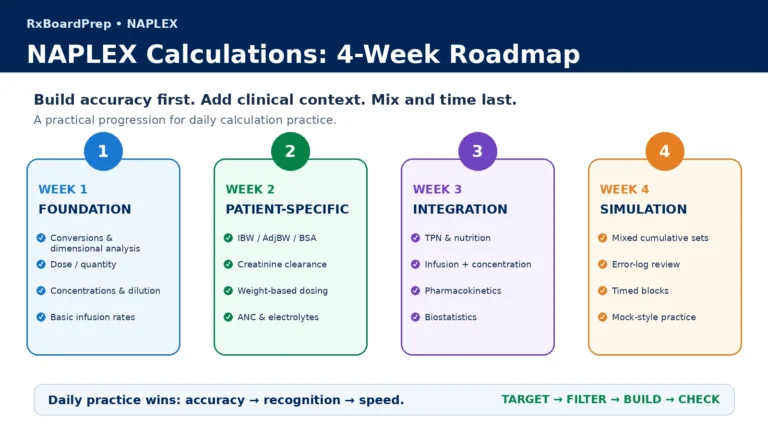
Calculation fluency benefits from frequent practice throughout NAPLEX preparation. The NAPLEX calculations 4-week practice plan is built for exactly this window.
Step 5 — Take Mock Exam 2
Once you have done enough targeted study to address what Mock Exam 1 exposed — for many candidates a few weeks, though it depends on your timeline and how much needed repairing — sit Mock Exam 2 in Timed mode.
Step 6 — Compare patterns, not just totals
This is the step people skip, and it is the one that carries the information. Two candidates can both move from 60% to 68% with completely different things happening underneath. Look for shifts like these:
- Fewer calculation setup entries, even if arithmetic slips remain
- More accurate interpretation of laboratory values
- Fewer missed contraindications and interactions
- Better time management — you finished, or you finished with less panic
- Fewer over-selections on select-all-that-apply items
- Faster identification of the decisive facts in long patient cases
A similar total score with a cleaner error pattern can still show meaningful progress and identify the next priority.
Do Not Judge Readiness From the Score Alone
RxBoardPrep Mock Exam 2 is not an official NABP examination, and its raw percentage is not a NAPLEX result.
- It does not convert to a NAPLEX scaled score.
- It does not guarantee that you will pass, and it does not mean you will fail.
- It should be read as a diagnostic signal about your current preparation, nothing more.
The useful information is in your error log, not the total. Two candidates can both score 66% — one sitting mostly in the arithmetic category, the other in clinical prioritization — and they need completely different plans for the next one to two weeks. The shared percentage tells you nothing about that.
So resist the urge to compare your number to someone else’s, or to a threshold you read in a forum. Let the categories drive what you do next.
Use the 5S Method After the Mock
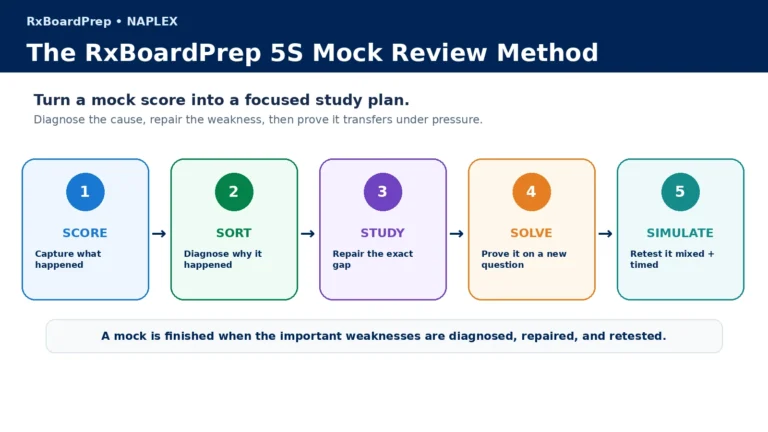
Reviewing a mock exam well is a skill in its own right, and doing it badly — reading the rationale, nodding, moving on — wastes most of the value of having sat the exam. RxBoardPrep uses a five-step review structure:
- Score — record the result and the conditions honestly
- Sort — apply the error categories from Step 2
- Study — repair the concepts behind the largest groups
- Solve — work new questions in those areas
- Simulate — return to timed conditions to confirm the repair held
The full walkthrough is in how to review a NAPLEX mock exam: the 5S method. Read it before you review Mock Exam 2 rather than after.
If Calculations Are Your Main Weakness
If your log fills up with calculation setup and arithmetic entries, these five moves address them directly.
- Separate setup errors from arithmetic errors. The wrong equation is a conceptual gap; the right equation with a mistyped number is an execution problem. They need different fixes.
- Redo every missed calculation from scratch. Reading a worked solution can help, but it does not prove that you can reproduce the setup independently.
- Write units on every line. A large share of calculation errors are unit errors, and they become visible the moment you stop omitting them.
- Practice in short, frequent sessions. This is usually more useful for maintaining fluency than occasional marathon sessions.
- Return to your weak categories deliberately. If renal dosing failed you once, it will fail you again unless you go back to it specifically.
For a structured four-week schedule covering dosing, TPN, creatinine clearance, infusion rates, pharmacokinetics and biostatistics, work through the NAPLEX calculations practice plan.
If Clinical Cases Are Your Main Weakness
Losing points on case questions while performing well on shorter items usually means the knowledge is there and the extraction is not. That is a trainable problem.
- Name the decisive factors out loud. After each case, say which two or three pieces of information determined the answer. If you cannot, you answered on impression.
- Drill medication-list scanning on its own. Take any list of eight to ten drugs and find the duplicate therapy, the unmatched indication, and the interaction — without a question attached.
- Interpret the labs before you read the options. Decide what the values mean while your thinking is still uncontaminated by four plausible-looking answers.
- Screen for contraindications first, appropriateness second. Safety eliminates faster than efficacy does.
- Explain why each wrong option is wrong. This is one of the most useful habits in case review. If three distractors are simply “not the answer” to you, you have not finished the question.
A Simple 7-Day Repair Plan After Mock Exam 2
A focused seven-day block can turn one mock exam into an actionable repair cycle.
| Day | Focus |
|---|---|
| 1 | Review every missed and guessed item and complete your error log. |
| 2 | Calculation and biostatistics entries. Rework each one from scratch, units included. |
| 3 | Your highest-error clinical system. Concepts first, then fresh questions in that area. |
| 4 | Medication safety: interactions, contraindications, duplicate therapy, and laboratory interpretation. |
| 5 | Your second weakest clinical area, worked the same way as day 3. |
| 6 | Mixed practice without notes, drawing across everything from days 2–5. |
| 7 | A short timed simulation, then a final pass through the error log to confirm what has closed. |
Treat this as a template rather than a prescription. If your log is overwhelmingly quantitative, days 3 and 5 should probably become calculation days too.
Where Mock Exam 2 Fits in Your NAPLEX Preparation
Mock Exam 2 is one checkpoint in a longer sequence. Placed correctly, it looks like this:
- Understand the blueprint using the current NAPLEX content outline.
- Establish a baseline with Free NAPLEX Mock Exam 1.
- Study the specific weaknesses it exposed, supported by the RxBoardPrep study guides.
- Keep calculations moving with the 4-week calculations plan.
- Re-measure with Mock Exam 2 on entirely new questions.
- Review it properly using the 5S method.
- Add structure if the same weaknesses keep returning.
You can browse everything free in the Free Practice Exams hub. If the same gaps keep returning despite targeted repair, you may benefit from a more structured, sequenced study plan — you can compare options on the pricing page.
Want a structured NAPLEX plan around these mocks?
RxBoardPrep NAPLEX Prep sequences content review, calculations, clinical reasoning practice, and repeated assessment so that the work between mock exams is planned rather than improvised.
Frequently Asked Questions
Is NAPLEX Mock Exam 2 free?
Yes. Mock Exam 2 is free to take, in the same way as Mock Exam 1. There is no payment step and no trial period.
Do I need an account?
No. You can take the exam anonymously. Signing in before you start keeps your attempt history attached to your student account, which is useful if you plan to compare Mock 1 and Mock 2 later.
How many questions are in Mock Exam 2?
Thirty: 21 single-choice, 4 select-all-that-apply, 4 numeric-entry, and 1 ordered-response question.
How long should I allow?
Timed mode runs for 50 minutes. Allow around 90 minutes in total if you plan to review your answers in the same sitting; reviewing soon afterward can be useful while your reasoning is still fresh.
Should I use Timed or Study mode?
Use Timed mode for a first attempt or any readiness check. Use Study mode when you are learning or working back through a weak area and want time to reason properly.
Is Mock Exam 2 harder than Mock Exam 1?
Not intentionally. Mock Exam 2 is a separate, independent mixed-domain assessment designed to complement Mock Exam 1. Because the questions are entirely different, individual students may find one set harder depending on their own strengths and weaknesses.
Is the percentage score equivalent to the real NAPLEX score?
No. This is an independent practice exam and its raw percentage does not convert to a NAPLEX scaled score or predict a pass or fail outcome. Use it to identify what to work on, not to estimate your result.
Should I take Mock 1 before Mock 2?
In most cases yes, with study time in between. Taking them on consecutive days gives you two scores and very little insight.
Does the mock include calculations and patient cases?
Yes to both. Approximately 8 questions involve quantitative reasoning, four of them as direct numeric entry, and roughly two thirds are case-based or application-based, including several detailed patient profiles with medication lists, laboratory values and vital signs.
What should I do after finishing the mock?
Review it the same day while the reasoning is still fresh, complete your error log, and build a short repair plan from the largest categories. The 5S method and the seven-day plan above both give you a structure for doing this.
Sources and Methodology
Mock Exam 2 was written and reviewed against the following:
- The current NABP NAPLEX Content Outline, effective May 1, 2025, including its five domains and published weights
- Contemporary United States pharmacy practice references
- FDA-approved prescribing information for the medications involved
- CDC and ACIP recommendations where immunization content applies
- Current professional clinical practice guidelines
- United States Pharmacopeia standards where compounding or quality content applies
- RxBoardPrep educational design standards and analysis of student feedback and recurring preparation challenges
Student feedback was used to guide educational emphasis and practice design, not to reproduce or reconstruct actual NAPLEX questions. All questions are original work created for RxBoardPrep. Clinical content is reviewed against current guidance at the time of writing, and questions are revised as practice standards change.
RxBoardPrep is an independent pharmacy education platform and is not affiliated with, endorsed by, or sponsored by the National Association of Boards of Pharmacy (NABP). NAPLEX is a registered trademark of NABP.