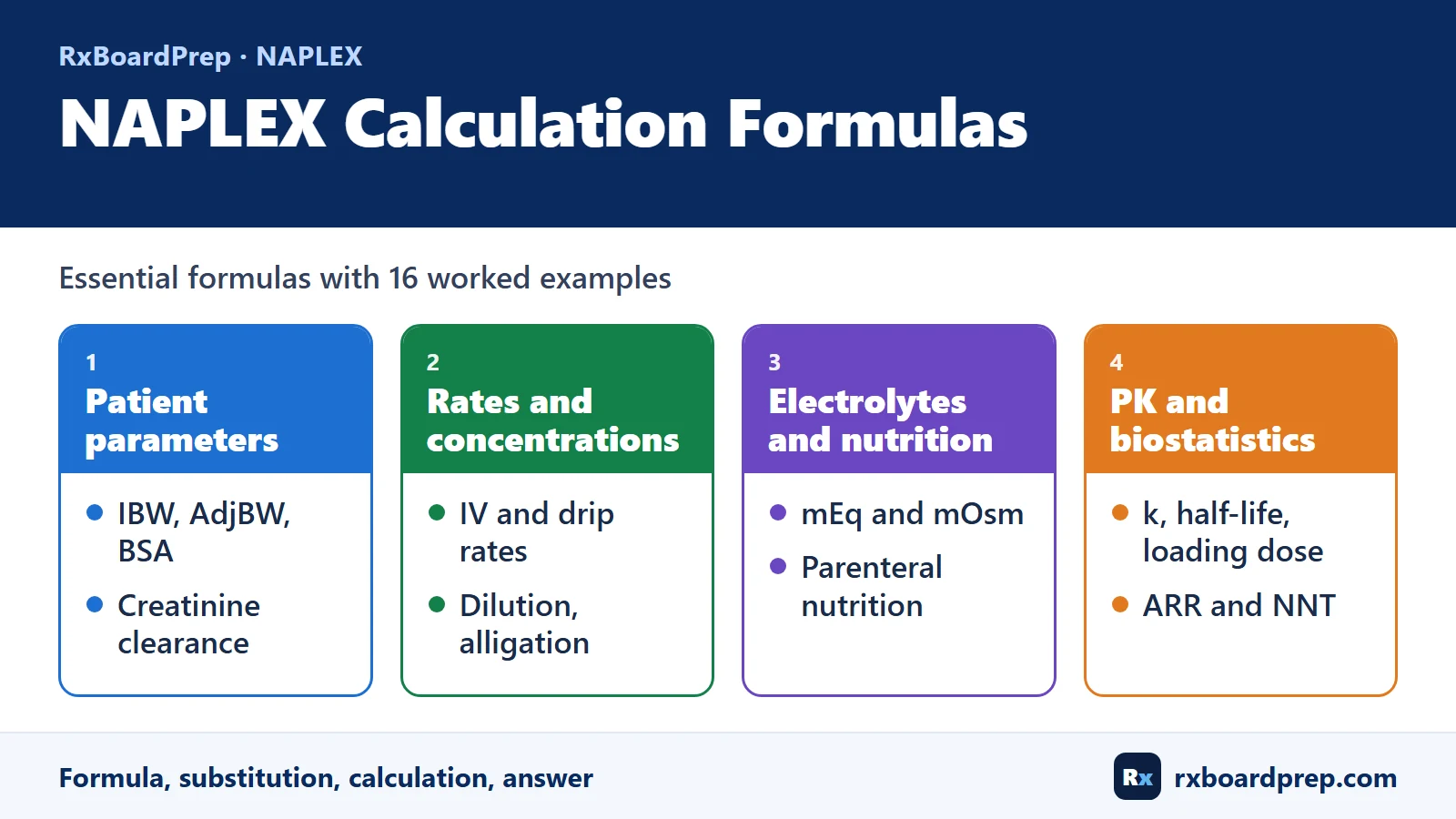
NAPLEX Calculations: Essential Formulas With Worked Examples
Calculations appear throughout the North American Pharmacist Licensure Examination (NAPLEX). The National Association of Boards of Pharmacy (NABP) lists pharmaceutical calculations in Domain 1 of its NAPLEX Content Outline, covering patient parameters, quantities, rates of administration, dose conversions, concentrations and osmolarity, compounding, nutrition, biostatistical measures and pharmacokinetic parameters. NABP’s Bulletin also notes that the exam provides an on-screen calculator and that many NAPLEX calculations will require its scientific mode.
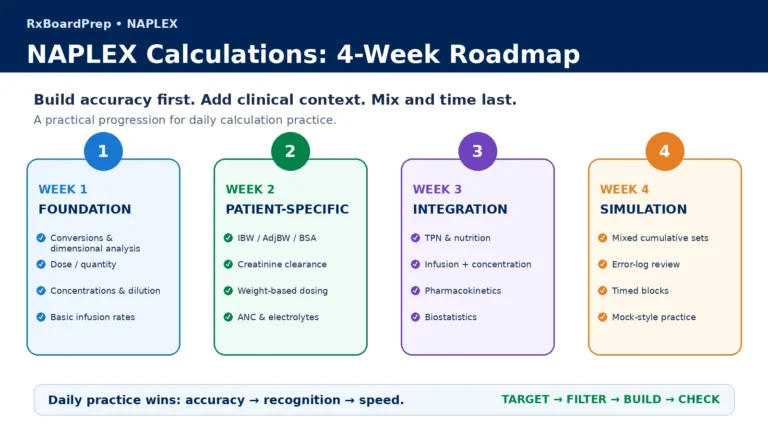
This guide is a formula reference you can practice from. Each formula is followed by an original worked example in the same four steps: Formula, Substitution, Calculation, Final answer. Work each one yourself before reading the solution. For a day-by-day practice schedule, use our 4-week NAPLEX calculations practice plan; this page is the formula companion to that plan.
Two habits matter more than any single formula:
- Write the units at every step. If the units do not cancel to what the question asks for, the setup is wrong.
- Round only at the end, and only as the question instructs. Rounding intermediate values can shift a numeric answer outside the accepted range.
Patient parameters
Ideal body weight and adjusted body weight
Formula. Ideal body weight (IBW), Devine method: men, IBW (kg) = 50 + 2.3 × (height in inches over 5 feet); women, IBW (kg) = 45.5 + 2.3 × (height in inches over 5 feet). Adjusted body weight (AdjBW) = IBW + 0.4 × (actual body weight − IBW).
Example 1. A man is 5 ft 8 in tall and weighs 102 kg. Calculate his IBW and AdjBW.
- Substitution: height over 5 feet = 8 in. IBW = 50 + 2.3 × 8. AdjBW = IBW + 0.4 × (102 − IBW).
- Calculation: IBW = 50 + 18.4 = 68.4 kg. Actual weight is 102 ÷ 68.4 = 1.49, or 149% of IBW. AdjBW = 68.4 + 0.4 × 33.6 = 68.4 + 13.44 = 81.84 kg.
- Final answer: IBW 68.4 kg; AdjBW 81.84 kg (about 81.8 kg).
Trap: the Devine formula needs height in inches. Convert centimeters first (1 in = 2.54 cm).
Creatinine clearance (Cockcroft-Gault)
Formula. Creatinine clearance (CrCl, mL/min) = [(140 − age) × weight (kg)] ÷ [72 × serum creatinine (SCr, mg/dL)], multiplied by 0.85 for women.
Which weight to use is the most common source of error. A widely taught convention is to use actual weight when it is below IBW, IBW when actual weight is close to IBW, and AdjBW when actual weight is well above IBW. The cut-off is a convention, not a fixed rule: 120% of IBW and 130% of IBW are both common, and institutions and references differ. Always follow the weight or cut-off the question specifies.
Example 2. The man in Example 1 is 68 years old with an SCr of 1.4 mg/dL. Estimate his CrCl using AdjBW.
- Substitution: CrCl = [(140 − 68) × 81.84] ÷ (72 × 1.4).
- Calculation: 140 − 68 = 72, and 72 × 81.84 = 5,892.5. 72 × 1.4 = 100.8. 5,892.5 ÷ 100.8 = 58.5.
- Final answer: about 58 mL/min.
Notice how much the weight choice matters. With actual weight (102 kg) the result is about 73 mL/min, and with IBW (68.4 kg) about 49 mL/min. For a drug whose dose changes at 50 or 60 mL/min, those differences change the answer.
Example 3. A 79-year-old woman is 5 ft 3 in tall, weighs 52 kg and has an SCr of 0.9 mg/dL. Estimate her CrCl.
- Substitution: her IBW = 45.5 + 2.3 × 3 = 52.4 kg. Her actual weight (52 kg) is below IBW, so use actual weight. CrCl = [(140 − 79) × 52] ÷ (72 × 0.9) × 0.85.
- Calculation: 61 × 52 = 3,172. 72 × 0.9 = 64.8. 3,172 ÷ 64.8 = 48.95. 48.95 × 0.85 = 41.6.
- Final answer: about 42 mL/min.
Traps: forgetting the 0.85 factor for women; using an estimated glomerular filtration rate (eGFR, reported in mL/min/1.73 m²) when the question asks for CrCl (mL/min). Some clinicians round a low SCr up in older adults; do this only if the question tells you to.
Dose by weight
Formula. Daily dose (mg) = dose (mg/kg/day) × weight (kg). Dose per administration = daily dose ÷ number of doses per day. Volume = dose ÷ concentration.
Example 4. A child weighs 33 lb. The prescriber orders a drug at 45 mg/kg/day divided every 12 hours. The oral suspension contains 400 mg/5 mL. How many mL are given per dose?
- Substitution: weight = 33 lb ÷ 2.2 lb/kg. Daily dose = 45 mg/kg/day × weight. Per dose = daily dose ÷ 2. Volume = per-dose mg × (5 mL ÷ 400 mg).
- Calculation: 33 ÷ 2.2 = 15 kg. 45 × 15 = 675 mg/day. 675 ÷ 2 = 337.5 mg per dose. 337.5 × 5 ÷ 400 = 4.22 mL.
- Final answer: 4.2 mL every 12 hours.
Trap: “mg/kg/day divided every 12 hours” means split the daily total; “mg/kg every 12 hours” means each dose is weight-based. Check any maximum dose stated in the question before you finalize.
Dose by body surface area (Mosteller)
Formula. Body surface area (BSA, m²) = √[height (cm) × weight (kg) ÷ 3,600]. Dose = dose (mg/m²) × BSA.
Example 5. A patient is 172 cm tall and weighs 81 kg. A regimen calls for 75 mg/m². Calculate the BSA and the dose.
- Substitution: BSA = √(172 × 81 ÷ 3,600). Dose = 75 mg/m² × BSA.
- Calculation: 172 × 81 = 13,932. 13,932 ÷ 3,600 = 3.87. √3.87 = 1.967 m² (about 1.97 m²). 75 × 1.967 = 147.5 mg.
- Final answer: BSA 1.97 m²; dose about 148 mg.
Trap: the 3,600 divisor applies only to centimeters and kilograms. A version using inches and pounds uses 3,131 instead.
Rates of administration
Flow rate in mL/h and drops per minute
Formula. Flow rate (mL/h) = total volume (mL) ÷ time (h). Drip rate (gtt/min) = volume (mL) × drop factor (gtt/mL) ÷ time (min).
Example 6. 1,000 mL of fluid is to run over 6 hours through a set with a drop factor of 20 gtt/mL. Give the rate in mL/h and gtt/min.
- Substitution: mL/h = 1,000 mL ÷ 6 h. gtt/min = 1,000 mL × 20 gtt/mL ÷ 360 min.
- Calculation: 1,000 ÷ 6 = 166.7 mL/h. 20,000 ÷ 360 = 55.6 gtt/min.
- Final answer: 167 mL/h; 56 gtt/min (drops are whole numbers).
Trap: using hours in the drip-rate formula. 6 hours is 360 minutes.
Weight-based continuous infusions
Formula. Rate (mL/h) = dose (mcg/kg/min) × weight (kg) × 60 min/h ÷ concentration (mcg/mL).
Example 7. Dopamine 400 mg in 250 mL is ordered at 5 mcg/kg/min for a 78 kg patient. What rate in mL/h should the pump be set to? If the pump were later found running at 20 mL/h, what dose would the patient be receiving?
- Substitution: concentration = 400 mg ÷ 250 mL = 1.6 mg/mL = 1,600 mcg/mL. Rate = 5 × 78 × 60 ÷ 1,600.
- Calculation: 5 × 78 = 390 mcg/min. 390 × 60 = 23,400 mcg/h. 23,400 ÷ 1,600 = 14.6 mL/h. Reverse: 20 mL/h × 1,600 mcg/mL = 32,000 mcg/h; ÷ 60 = 533 mcg/min; ÷ 78 kg = 6.8 mcg/kg/min.
- Final answer: 14.6 mL/h; at 20 mL/h the dose is about 6.8 mcg/kg/min.
Trap: forgetting to convert mg to mcg (× 1,000) or minutes to hours (× 60). Writing the target unit, mL/h, before you start keeps both conversions visible.
Concentrations and compounding
Percent strength, ratio strength and mg/mL
Formula. % w/v = grams per 100 mL, so 1% w/v = 1 g/100 mL = 10 mg/mL. Ratio strength 1:x means 1 g in x mL (for solids in liquids). To convert a percentage to ratio strength, divide 100 by the percentage: 1:(100 ÷ %).
Example 8. Express a 0.02% w/v solution as mg/mL and as a ratio strength. Then give the concentration of a 1:1,000 solution in mg/mL.
- Substitution: 0.02% w/v = 0.02 g/100 mL. Ratio = 1:(100 ÷ 0.02). 1:1,000 = 1 g/1,000 mL.
- Calculation: 0.02 g = 20 mg, so 20 mg/100 mL = 0.2 mg/mL. 100 ÷ 0.02 = 5,000. 1 g/1,000 mL = 1,000 mg/1,000 mL = 1 mg/mL.
- Final answer: 0.02% w/v = 0.2 mg/mL = 1:5,000; 1:1,000 = 1 mg/mL.
Trap: a larger number in a ratio strength means a weaker solution. 1:10,000 is ten times weaker than 1:1,000.
Dilution (C1V1 = C2V2)
Formula. C1 × V1 = C2 × V2, where C1 and V1 are the stock concentration and volume, and C2 and V2 the final concentration and volume. Both concentrations must be in the same unit.
Example 9. How many mL of a 2% w/v stock solution are needed to prepare 240 mL of a 0.05% w/v solution, and how much diluent is added?
- Substitution: 2% × V1 = 0.05% × 240 mL.
- Calculation: V1 = (0.05 × 240) ÷ 2 = 12 ÷ 2 = 6 mL. Diluent = 240 − 6 = 234 mL.
- Final answer: 6 mL of stock plus 234 mL of diluent.
Trap: C1V1 = C2V2 applies when you dilute with a vehicle that contains no drug. When you mix two drug-containing products of different strengths, use alligation instead.
Alligation
Formula. Place the higher and lower strengths on the left and the desired strength in the middle. Parts of higher strength = desired − lower. Parts of lower strength = higher − desired. Quantity of each = (its parts ÷ total parts) × total quantity.
Example 10. Prepare 120 g of a 2.5% ointment from a 5% ointment and a 1% ointment. How many grams of each are needed?
- Substitution: parts of 5% = 2.5 − 1 = 1.5. Parts of 1% = 5 − 2.5 = 2.5. Total = 4 parts.
- Calculation: 5%: 1.5 ÷ 4 × 120 = 45 g. 1%: 2.5 ÷ 4 × 120 = 75 g. Check: (45 × 0.05) + (75 × 0.01) = 2.25 + 0.75 = 3 g of drug in 120 g = 2.5%.
- Final answer: 45 g of the 5% ointment and 75 g of the 1% ointment.
Trap: stopping at the ratio (1.5 : 2.5) without converting it into grams.
Electrolytes and osmolarity
Milliequivalents
Formula. mEq = [weight (mg) × valence] ÷ molecular weight (MW). Millimoles (mmol) = weight (mg) ÷ MW.
Example 11. How many mEq of magnesium are in 2 g of magnesium sulfate heptahydrate (MgSO4·7H2O, MW 246.5)?
- Substitution: mEq = (2,000 mg × 2) ÷ 246.5. The valence of magnesium is 2.
- Calculation: 4,000 ÷ 246.5 = 16.2 mEq. (That is 2,000 ÷ 246.5 = 8.1 mmol.)
- Final answer: about 16.2 mEq of magnesium (8.1 mmol).
Traps: using a valence of 1 for a divalent ion such as magnesium or calcium; using the anhydrous MW (about 120.4) when the question specifies the heptahydrate. Read which salt form is stated.
Osmolarity
Formula. mOsm/L = [concentration (g/L) ÷ MW (g/mol)] × number of particles × 1,000. Assume complete dissociation unless the question gives a dissociation factor.
Example 12. Estimate the osmolarity of 5% dextrose in water (D5W, dextrose monohydrate, MW 198) containing 20 mEq/L of potassium chloride (KCl).
- Substitution: dextrose: 50 g/L ÷ 198 g/mol × 1 particle × 1,000. KCl: 20 mEq/L of a monovalent salt = 20 mmol/L, and each KCl gives 2 particles.
- Calculation: 50 ÷ 198 × 1,000 = 252.5 mOsm/L. 20 × 2 = 40 mOsm/L. Total = 292.5 mOsm/L.
- Final answer: about 293 mOsm/L.
Trap: dextrose does not dissociate, so it contributes 1 particle per molecule. Osmolarity is per liter of solution; osmolality is per kilogram of solvent, and the question will say which one it wants.
Parenteral nutrition basics
Formula. Dextrose (monohydrate) provides 3.4 kcal/g. Protein (amino acids) provides 4 kcal/g. Lipid injectable emulsions provide a product-specific amount, for example 2 kcal/mL for a 20% emulsion; use the value the question or product labeling gives. Nitrogen (g) = protein (g) ÷ 6.25. Nonprotein calories (NPC) = dextrose kcal + lipid kcal.
Example 13. A daily parenteral nutrition (PN) order for a 68 kg adult provides 250 g dextrose, 80 g amino acids and 250 mL of a 20% lipid injectable emulsion (2 kcal/mL). Calculate total kcal, kcal/kg/day, protein in g/kg/day and the NPC-to-nitrogen ratio.
- Substitution: dextrose 250 × 3.4; protein 80 × 4; lipid 250 × 2. Nitrogen = 80 ÷ 6.25.
- Calculation: dextrose 850 kcal; protein 320 kcal; lipid 500 kcal. Total = 1,670 kcal; 1,670 ÷ 68 = 24.6 kcal/kg/day. Protein 80 ÷ 68 = 1.18 g/kg/day. NPC = 850 + 500 = 1,350 kcal. Nitrogen = 12.8 g. NPC:N = 1,350 ÷ 12.8 = 105.5.
- Final answer: 1,670 kcal/day (about 24.6 kcal/kg/day); protein about 1.2 g/kg/day; NPC:N about 105:1.
Traps: using 4 kcal/g for dextrose (4 kcal/g is the general value for dietary carbohydrate, but IV dextrose is the monohydrate, at 3.4 kcal/g); including protein calories in the NPC; using the lipid emulsion’s percentage as if it were kcal/mL.
Pharmacokinetics
Elimination rate constant and half-life
Formula. For first-order elimination, k = ln(C1 ÷ C2) ÷ Δt, and half-life (t½) = 0.693 ÷ k.
Example 14. A drug’s plasma concentration is 24 mg/L at 08:00 and 6 mg/L at 18:00, with no dose in between. Calculate k and t½. How long after 18:00 will the concentration reach 1.5 mg/L?
- Substitution: k = ln(24 ÷ 6) ÷ 10 h. t½ = 0.693 ÷ k.
- Calculation: ln 4 = 1.3863. k = 1.3863 ÷ 10 = 0.13863 h⁻¹, shown rounded as 0.139 h⁻¹. t½ = 0.693 ÷ 0.13863 = 5.0 h. From 6 to 1.5 mg/L is two more half-lives: 2 × 5 = 10 h.
- Final answer: k = 0.1386 h⁻¹ (about 0.139 h⁻¹); t½ = 5 h; 1.5 mg/L is reached at about 04:00 the next day, 10 hours after 18:00.
Shortcut check: 24 to 12 to 6 is two half-lives in 10 hours, so t½ = 5 h before you touch the calculator.
Loading dose
Formula. Loading dose (LD) = [volume of distribution (Vd, L) × target concentration (mg/L)] ÷ (S × F), where S is the salt fraction and F the bioavailability (both 1 unless stated).
Example 15. A drug has a Vd of 0.6 L/kg. An 80 kg patient needs a target plasma concentration of 15 mg/L. Calculate the IV loading dose, and the oral loading dose if oral bioavailability is 0.8.
- Substitution: Vd = 0.6 × 80 = 48 L. IV LD = 48 × 15 ÷ (1 × 1). Oral LD = 48 × 15 ÷ (1 × 0.8).
- Calculation: 48 × 15 = 720 mg. 720 ÷ 0.8 = 900 mg.
- Final answer: IV 720 mg; oral 900 mg.
Trap: forgetting to multiply Vd in L/kg by body weight, which gives a dose 80 times too small.
Biostatistics: absolute risk reduction and NNT
Formula. Absolute risk reduction (ARR) = control event rate − treatment event rate. Relative risk reduction (RRR) = ARR ÷ control event rate. Number needed to treat (NNT) = 1 ÷ ARR (ARR as a decimal), rounded up to the next whole number.
Example 16. In a 3-year trial, 12% of patients in the placebo group and 9% in the treatment group had a heart attack. Calculate the ARR, RRR and NNT.
- Substitution: ARR = 0.12 − 0.09. RRR = ARR ÷ 0.12. NNT = 1 ÷ ARR.
- Calculation: ARR = 0.03 (3%). RRR = 0.03 ÷ 0.12 = 0.25 (25%). NNT = 1 ÷ 0.03 = 33.3, rounded up to 34.
- Final answer: ARR 3%; RRR 25%; NNT 34 over 3 years.
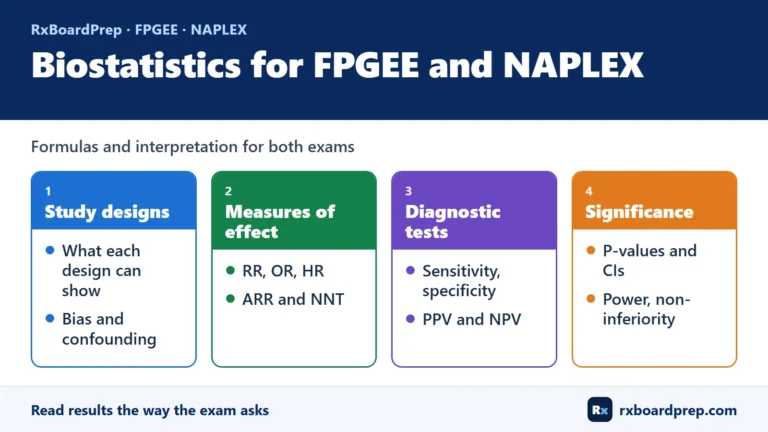
Traps: using percentages instead of decimals in 1 ÷ ARR (1 ÷ 3 is not 34); quoting the NNT without its time frame. For more on these measures, see our guide to biostatistics for the FPGEE and NAPLEX.
Quick formula table
| Calculation | Formula | Watch for |
|---|---|---|
| IBW (Devine) | Men 50 kg, women 45.5 kg, + 2.3 kg per inch over 5 ft | Height in inches |
| AdjBW | IBW + 0.4 × (actual − IBW) | When to use it |
| CrCl (Cockcroft-Gault) | (140 − age) × weight ÷ (72 × SCr), × 0.85 for women | Weight choice; CrCl vs eGFR |
| BSA (Mosteller) | √(cm × kg ÷ 3,600) | Units match the divisor |
| Flow rate | mL ÷ h | Hours vs minutes |
| Drip rate | mL × gtt/mL ÷ min | Round to whole drops |
| Weight-based infusion | mcg/kg/min × kg × 60 ÷ mcg/mL | mg to mcg |
| Percent w/v | g per 100 mL | 1% = 10 mg/mL |
| Ratio strength | 1 g in x mL | Bigger x, weaker |
| Dilution | C1V1 = C2V2 | Same units both sides |
| Alligation | Parts = differences across | Convert parts to amounts |
| mEq | mg × valence ÷ MW | Salt form and valence |
| Osmolarity | g/L ÷ MW × particles × 1,000 | Dissociation |
| PN calories | Dextrose 3.4, protein 4 kcal/g; lipid per product | NPC excludes protein |
| Half-life | t½ = 0.693 ÷ k | ln, not log |
| Loading dose | Vd × C ÷ (S × F) | Vd per kg × weight |
| NNT | 1 ÷ ARR, round up | Decimal ARR; time frame |
Free printable: NAPLEX Calculations Quick-Reference
Every formula in this guide on one printable reference, with units, common conversions, a list of frequent traps and eight more original worked examples. US Letter, free, no sign-up.
Practice the formulas in context
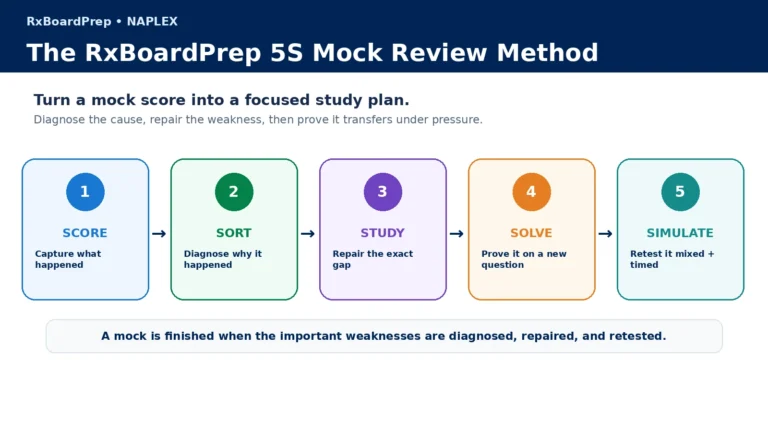
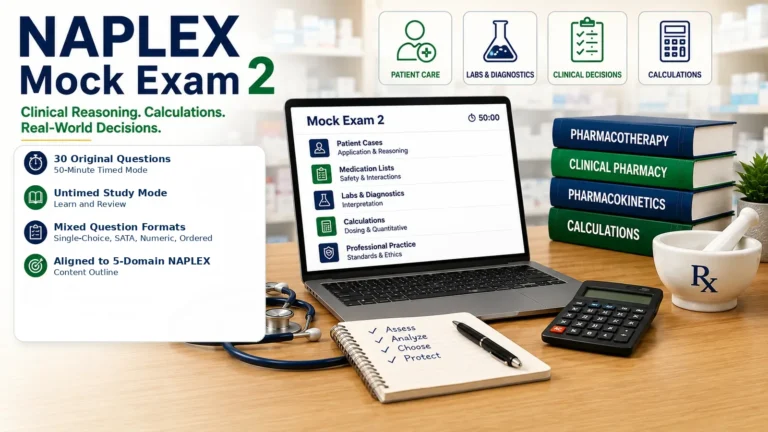
On the exam, these formulas usually arrive inside a patient case, with extra numbers you do not need. After you can work every example above without notes, practice choosing the right formula from a case. The free CalcQuest challenges on the RxBoardPrep Play page give you case-based renal dosing, alligation and infusion problems with a step-by-step solution after every answer, and no sign-up is needed. When you are ready to test calculations mixed with clinical questions under time pressure, take Free NAPLEX Mock Exam 1, then review your misses with the 5S mock review method. If you want calculations taught live alongside therapeutics, the RxBoardPrep NAPLEX Prep course includes CalcQuest’s full set of case-based calculation questions.
References
- National Association of Boards of Pharmacy. NAPLEX Content Outline (effective for examinations beginning 1 May 2025), Domain 1, section C, Pharmaceutical calculations. https://nabp.pharmacy/wp-content/uploads/NAPLEX-Content-Outline.pdf. Accessed 28 October 2026.
- National Association of Boards of Pharmacy. NAPLEX/MPJE Candidate Application Bulletin, “Taking Your Exams” (March 2026), on-screen calculator. https://read.nxtbook.com/nabp/bulletin/naplex_mpje_bulletin/taking_your_exams.html. Accessed 28 October 2026.
- Cockcroft DW, Gault MH. Prediction of creatinine clearance from serum creatinine. Nephron. 1976;16(1):31-41. https://doi.org/10.1159/000180580.
- Devine BJ. Gentamicin therapy. Drug Intell Clin Pharm. 1974;8:650-655 (source of the IBW equation).
- Mosteller RD. Simplified calculation of body-surface area. N Engl J Med. 1987;317(17):1098. https://doi.org/10.1056/NEJM198710223171717.
- Intralipid (lipid injectable emulsion) US prescribing information, DailyMed, US National Library of Medicine (caloric content of 20% emulsion). https://dailymed.nlm.nih.gov/dailymed/search.cfm?query=intralipid. Accessed 28 October 2026.
- Stockton SJ. Stoklosa and Ansel’s Pharmaceutical Calculations. 16th ed. Wolters Kluwer; 2021 (standard reference for concentration, dilution, alligation, milliequivalent and osmolarity methods).
- Laupacis A, Sackett DL, Roberts RS. An assessment of clinically useful measures of the consequences of treatment. N Engl J Med. 1988;318(26):1728-1733. https://doi.org/10.1056/NEJM198806303182605.
RxBoardPrep is an independent education provider and is not affiliated with or endorsed by NABP.
How this guide was prepared: drafted with AI assistance from the sources listed above, fact-checked against those sources, with every calculation independently recomputed before publication. Published by RxBoardPrep under the editorial oversight of Talha Shafique, PharmD, MPH.