How to Review a NAPLEX Mock Exam: The RxBoardPrep 5S Method
Taking a NAPLEX mock exam is useful.
Reviewing it correctly is where most of the improvement happens.
A student can take five practice exams and improve very little if every review looks like this:
“I got 72%. I read the explanations for the questions I missed. I’ll take another test next week.”
That tells you your score.
It does not tell you why you missed questions, whether the weakness has actually been repaired, or whether the same mistake will happen again under time pressure.
A better mock review should answer five questions:
- What happened?
- Why did it happen?
- What exactly needs to be repaired?
- Can I now solve a new question testing the same skill?
- Will the improvement survive under exam conditions?
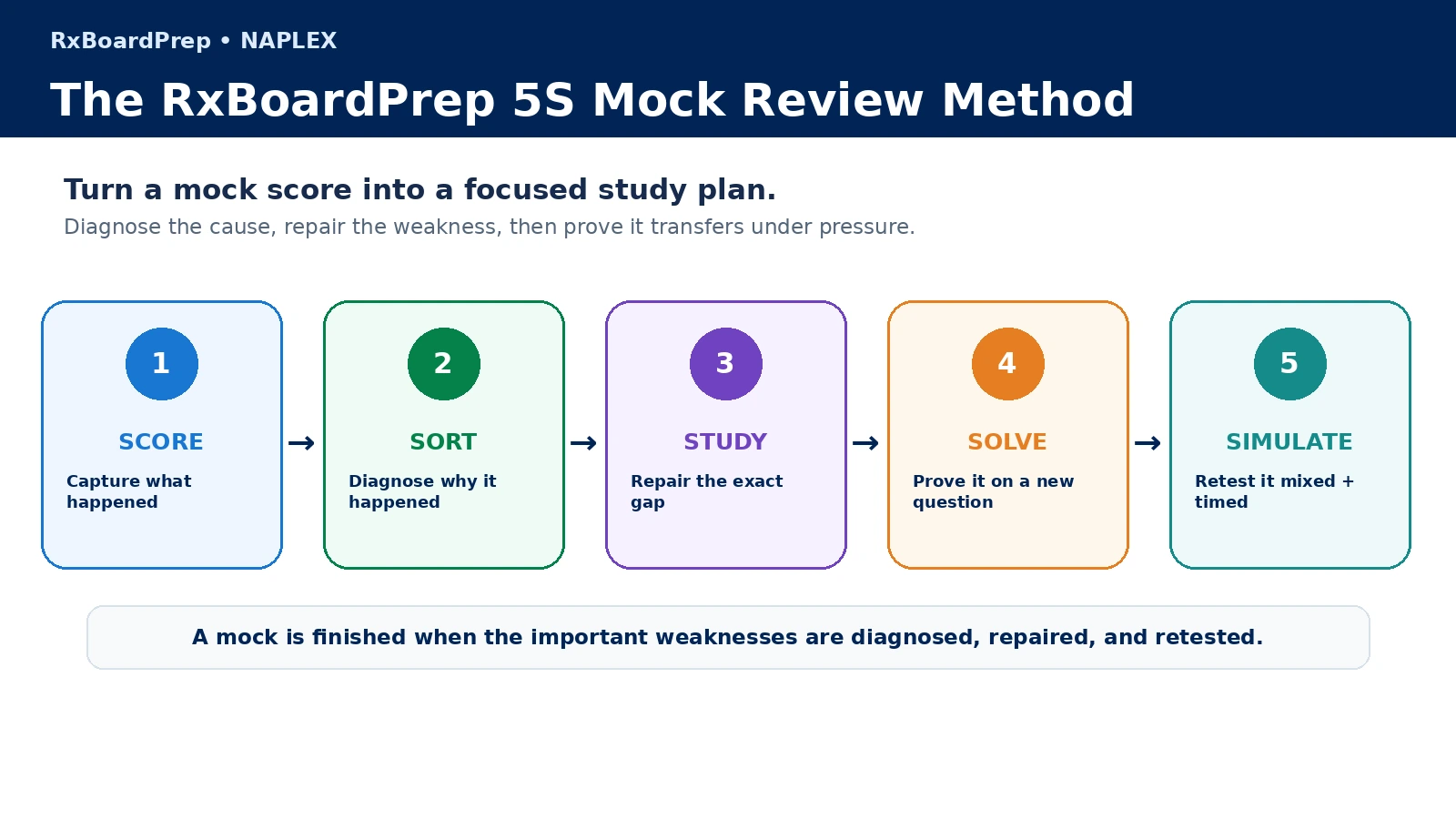
That is the purpose of the RxBoardPrep 5S Mock Review Method:
SCORE → SORT → STUDY → SOLVE → SIMULATE
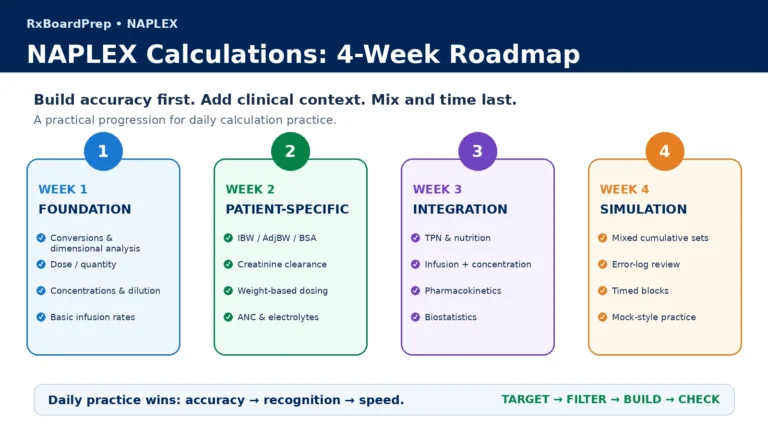
Use it after every serious NAPLEX practice exam. If calculations are one of the weaknesses your mock uncovers, use our NAPLEX calculations practice plan to turn that weakness into a structured daily routine.
Why Your Mock Score Is Only the Beginning
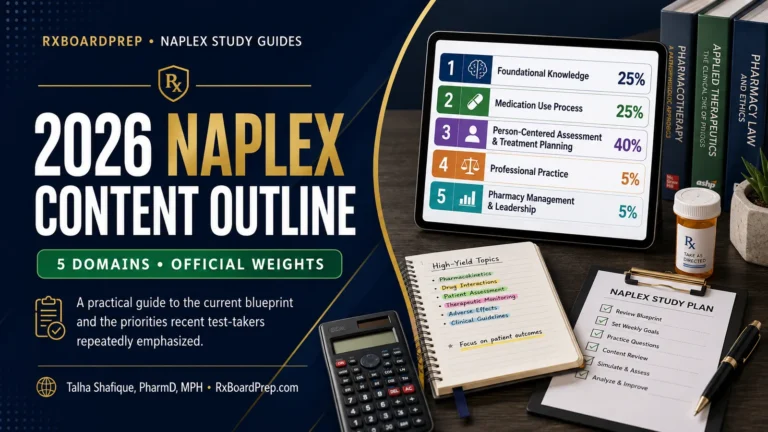
The current NABP NAPLEX Content Outline divides scored content across five domains.
Approximate exam weighting is:
- Foundational Knowledge for Pharmacy Practice — 25%
- Medication Use Process — 25%
- Person-Centered Assessment and Treatment Planning — 40%
- Professional Practice — 5%
- Pharmacy Management and Leadership — 5%
Person-Centered Assessment and Treatment Planning is therefore the largest single domain, but a NAPLEX candidate still needs broad performance across the examination.
That matters when you interpret a mock score.
Consider two students who both score 72%.
Student A
- Strong calculations
- Strong infectious disease
- Weak anticoagulation
- Weak oncology
- Several missed questions from rushing
Student B
- Weak calculations
- Strong cardiology
- Strong oncology
- Multiple errors interpreting laboratory values
- Good pacing
The number 72% does not tell these students what to do next.
Their next week of preparation should look completely different.
That is why the first rule of mock-exam review is:
Never let the total score become the entire diagnosis.
Working through a range of free NAPLEX and pharmacy practice exams makes those differences easier to see across sittings.
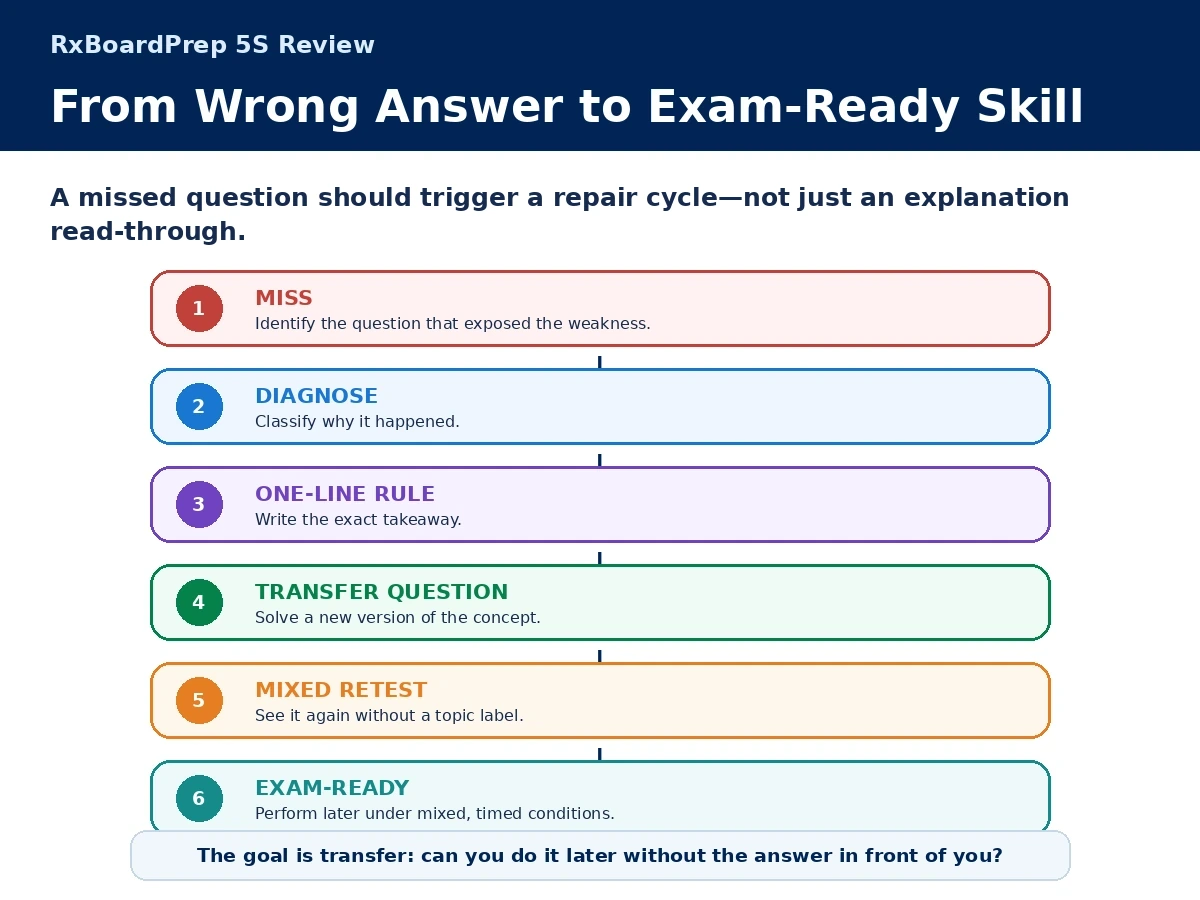
The RxBoardPrep 5S Method
The five stages are:
SCORE
Capture what actually happened.
SORT
Identify why each important question was missed.
STUDY
Repair the exact knowledge or reasoning gap.
SOLVE
Prove the repair using a new question.
SIMULATE
Prove it again later under mixed and timed conditions.
SCORE — Capture What Actually Happened
Before opening every explanation, record what happened while the experience is still fresh.
Your post-mock record should include more than the percentage.
Record:
- Overall accuracy
- Questions correct
- Questions incorrect
- Questions unanswered
- Time used
- Questions guessed
- Questions where you changed your answer
- Major topic or domain weaknesses
- Calculation errors
- Questions that took unusually long
- Confidence level during the exam
Build a Simple Score Sheet
| Metric | Example Result |
|---|---|
| Overall accuracy | 74% |
| Unanswered | 3 |
| Calculations | 7/10 |
| Clinical cases | 22/30 |
| SATA | 5/8 |
| Questions guessed | 14 |
| Changed answers | 6 |
| Average confidence | Medium |
| Main weakness | Renal dosing |
| Main pacing issue | Too slow early |
This is already more useful than simply writing:
Mock 2 = 74%.
Add a Confidence Score
For every difficult question, ask how confident you were before seeing the answer.
Use:
H — High confidence
“I was very sure.”
M — Medium confidence
“I narrowed it down but was uncertain.”
L — Low confidence
“I was largely guessing.”
This creates four especially useful categories.
Correct + High Confidence
This is the strongest result.
You probably understand the concept.
Still review briefly if it is a high-yield topic, but do not spend an hour relearning something you clearly know.
Correct + Low Confidence
This is a hidden weakness.
You received the point, but you may not get it next time.
A lucky correct answer can make your score look healthier than your knowledge really is.
Incorrect + Low Confidence
This is an expected weakness.
You did not know or could not apply the concept.
Identify the gap and repair it.
Incorrect + High Confidence
This is often the most valuable category in the entire mock.
You were confidently wrong.
That can mean:
- You learned a rule incorrectly.
- You overgeneralized a rule.
- You confused two similar concepts.
- You missed an exception.
- You misread the patient case.
- You have a persistent misconception.
These questions should move near the top of your review list.
Do Not Review in Question Order
Many students finish a mock and begin reviewing Question 1, then Question 2, then Question 3.
That is organized.
It is not always efficient.
Instead, sort first and review by educational value.
A useful priority order is:
- Confidently wrong
- High-yield concept missed
- Repeated error pattern
- Calculation or setup mistake
- Low-confidence correct answer
- Random obscure fact
This prevents one unusual trivia question from consuming the same study time as a repeated weakness in calculations, anticoagulation, renal dosing, pharmacokinetics, or patient assessment.
SORT — Diagnose Why the Question Was Missed
Do not write:
“Missed diabetes.”
That is a topic.
It is not a diagnosis.
Instead ask:
What kind of failure occurred?
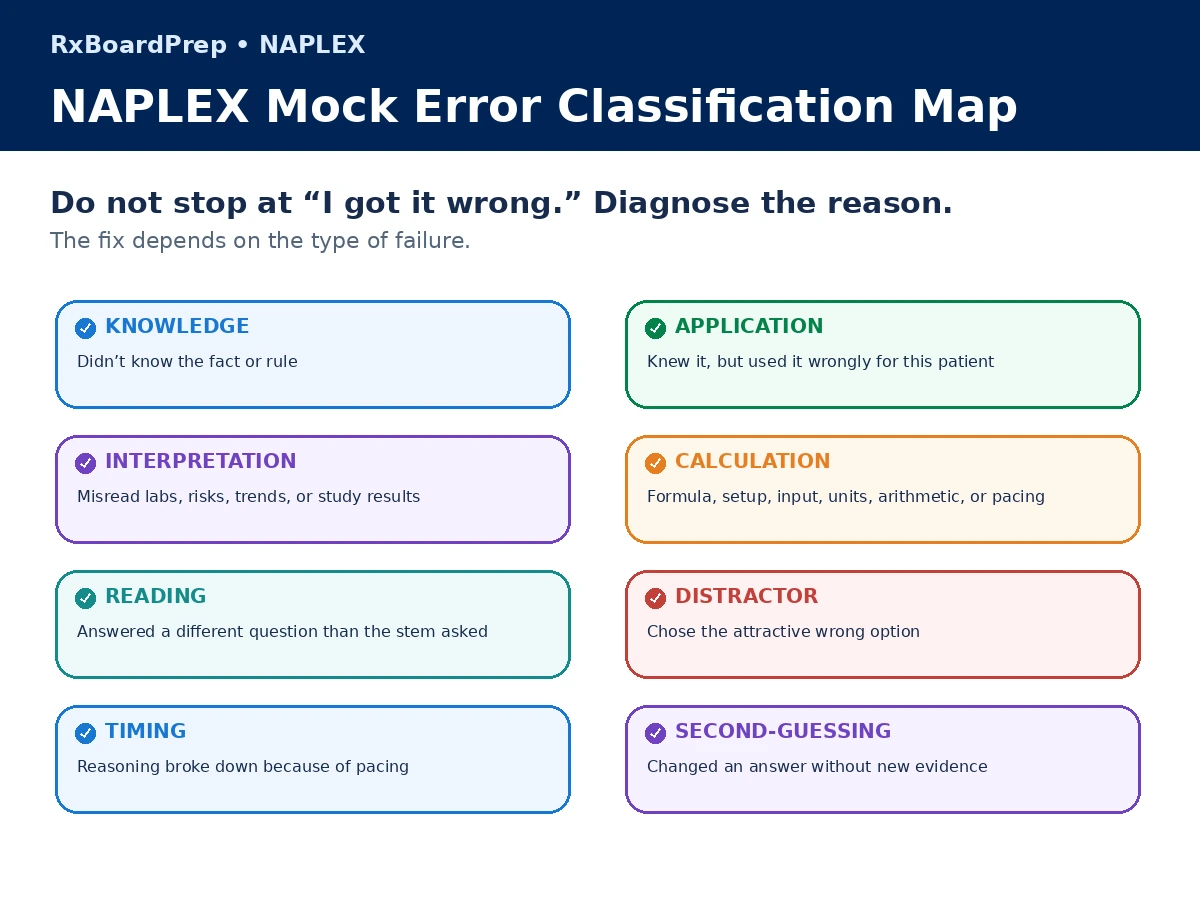
Use the RxBoardPrep error categories below.
Error Type 1 — Knowledge
You genuinely did not know the information required.
Examples:
- Did not know a major adverse effect
- Forgot an important interaction
- Did not know a vaccine contraindication
- Forgot a bug-drug relationship
- Did not recognize a brand/generic pair
- Did not remember the monitoring requirement
Do not write:
“Study anticoagulation.”
Write something specific:
“Confused the reversal strategy for Drug X.”
Specific gaps are repairable.
Broad labels are not.
Error Type 2 — Application
You knew the fact but did not apply it correctly to the patient.
For example, you know Drug A treats the disease.
But this patient also has:
- renal dysfunction
- pregnancy
- an important interaction
- an allergy
- a contraindication
- an abnormal laboratory value
and another choice is therefore more appropriate.
This distinction is critical.
Knowing what a drug does is not the same as selecting the best option for this patient.
Error Type 3 — Interpretation
You knew the disease and medication but misinterpreted:
- a laboratory value
- renal function
- vital signs
- culture data
- therapeutic drug level
- risk score
- study result
- confidence interval
- clinical trend
These errors can look like knowledge problems when the real weakness is interpreting the information already provided.
Error Type 4 — Calculation
Do not stop at:
“Math error.”
Break the error down further.
Formula or concept
You used the wrong relationship.
Setup
You understood the concept but arranged the calculation incorrectly.
Input selection
You selected the wrong patient weight, concentration, laboratory value, dose, or conversion factor.
Units
mg vs g · mL vs L · min vs hr · lb vs kg · mcg vs mg
Arithmetic
The setup was correct but the calculator work was wrong.
Rounding
You rounded too early or incorrectly.
Pacing
You could solve it, but it consumed too much time.
Error Type 5 — Reading
Sometimes you knew everything required to answer correctly.
You simply answered a different question.
Common examples:
- Stem asked NOT
- Asked for the best next step
- Asked which medication should be discontinued
- Asked which option is contraindicated
- Asked for initial therapy rather than long-term therapy
- Asked for monitoring rather than treatment
- Asked for an adverse effect rather than mechanism
Studying more pharmacology will not fix a reading-pattern problem.
It needs its own intervention.
Error Type 6 — Distractor
You narrowed the question to two choices but repeatedly selected the attractive wrong option.
Ask why.
Common distractor patterns include:
- generally true but wrong for this patient
- treats the condition but is not the best next step
- correct drug but wrong dose
- correct mechanism but wrong clinical implication
- addresses one abnormality while ignoring a more urgent problem
- familiar answer that does not actually answer the stem
Learning why the distractor attracted you can improve future elimination.
Error Type 7 — Timing
You knew the material but performance deteriorated because of pacing.
Examples:
- Spent too long on early calculations
- Reread long cases several times
- Refused to move on from an uncertain question
- Rushed the final section
- Left questions unanswered
- Lost time repeatedly checking simple work
This requires a pacing intervention—not another chapter reread.
Error Type 8 — Second-Guessing
You initially selected the correct answer and then changed it without new evidence.
Do not automatically adopt the rule:
“Never change answers.”
Changing an answer can be appropriate.
The better question is:
Why did I change it?
Good reason:
“I noticed a contraindication that I initially missed.”
Weak reason:
“Choice C suddenly looked too obvious.”
Track the pattern.
If repeated second-guessing is harming performance, it deserves deliberate correction.
Build a Mock Error Table
Your review should eventually look something like this:
| Q | Topic | Result | Confidence | Error Type | Exact Gap | Action |
|---|---|---|---|---|---|---|
| 7 | Anticoagulation | Wrong | High | Knowledge | Reversal rule confused | Review reversal table |
| 14 | CrCl | Wrong | Medium | Calculation | Wrong weight selected | Solve 5 weight-selection cases |
| 22 | Diabetes | Correct | Low | Application | Guessed benefit | Review patient-selection criteria |
| 31 | Infectious Disease | Wrong | High | Reading | Missed allergy | Case-reading drill |
| 43 | Biostatistics | Wrong | Low | Interpretation | RR meaning unclear | Relearn RR + solve 5 cases |
Now the mock exam has become a study plan.
That is the transition we want.
STUDY — Repair the Exact Gap
Only now should you begin targeted content review.
The key word is targeted.
Suppose you missed one question involving heart failure.
Do not automatically reread an entire heart-failure chapter.
Ask:
What exact knowledge would have allowed me to answer this question correctly?
Perhaps the gap was only:
- recognizing a drug class
- potassium monitoring
- renal-function consideration
- contraindication
- dose titration
- selecting therapy for a specific comorbidity
Repair that exact weakness first.
Use the Minimum Effective Review
For each important missed concept:
Step 1
Read the explanation.
Step 2
Identify the rule in one sentence.
Step 3
Return to your main notes or reference and confirm the concept.
Step 4
Write a short correction.
Example:
Error: Selected a potassium-raising medication despite elevated potassium.
Rule: Check the patient’s potassium and renal function before deciding whether the medication is appropriate.
That is more useful than copying an entire textbook paragraph.
The One-Line Rule
Every important missed question should produce a one-line takeaway.
Examples:
NNT uses absolute risk reduction, not relative risk reduction.
mg/kg/day divided every 8 hours is not the same as mg/kg/dose every 8 hours.
A correct drug choice can still be wrong if the patient has a contraindication.
When a stem asks for monitoring, do not answer with treatment.
Always interpret a risk ratio in the context of the event being measured.
These one-line rules gradually become your personalized rapid-review sheet.
After several mocks, you are no longer studying only a generic NAPLEX curriculum.
You are studying your own error profile.
When Should You Relearn the Whole Topic?
Sometimes one missed question reveals a larger weakness.
Use this rule:
One isolated miss
Targeted review.
Several misses within the same concept
Review the subtopic.
Repeated poor performance across the entire topic
Relearn the chapter or module.
Do not let one unusual question convince you that you have forgotten all of cardiology.
But do not ignore a pattern of repeated cardiology misses either.
SOLVE — Prove the Weakness Is Repaired
This is the step many students skip.
Reading an explanation feels productive.
But the real question is:
Can you now answer a different question testing the same concept?
You have not fully repaired a weakness until you demonstrate it on a new problem.
Do Not Immediately Repeat the Same Question
If you redo the same question five minutes later, you may remember:
“The answer was B.”
That is not the same as understanding the concept.
Instead, use a transfer question.
If you missed a creatinine-clearance question because you selected the wrong patient information, solve another renal-function case with a different patient.
If you missed an anticoagulation interaction, solve another interaction case.
If you missed NNT, solve another study-results problem using different event rates.
The new problem tests whether the rule transferred.
The 24–72 Hour Retest
A useful progression is:
Immediately after review
Understand the concept.
Within about 24 hours
Solve 1–3 new questions on it.
48–72 hours later
See the concept again inside a mixed set.
About one week later
Allow it to appear naturally in cumulative practice.
This progression is much more useful than repeatedly rereading the same explanation.
Use a Repair Score
For an important weakness, mark:
0 — Not repaired
Still confused.
1 — Understood after review
Can explain the rule.
2 — Reproduced
Solved a new targeted question correctly.
3 — Transferred
Solved it correctly later inside mixed or timed practice.
Do not consider a major recurring weakness truly repaired until it reaches 3.
SIMULATE — Put the Repaired Skill Back Under Pressure
The final step asks:
Can I still perform when the topic is mixed with everything else?
This matters because chapter-based practice gives you a clue.
If you open a section called Creatinine Clearance Practice, you already know which calculation is probably required.
If you open Anticoagulation Questions, you already know the disease area.
A real mixed exam gives you neither hint.
You have to identify the problem yourself.
Mixed Practice Is the Final Test
After targeted repair, mix the topic back into:
- therapeutics
- calculations
- laboratory interpretation
- medication safety
- biostatistics
- professional practice
- unrelated disease states
Your brain must repeatedly switch between different kinds of reasoning.
That is part of exam performance.
Add Time Pressure Last
Do not immediately time a concept you still do not understand.
Use this progression:
Stage 1 — Accurate and untimed
Stage 2 — Accurate with moderate pacing
Stage 3 — Mixed and timed
Stage 4 — Full mock conditions
Speed should be built on correct reasoning.
The 5S Method in One Table
| Step | Question You Ask | Output |
|---|---|---|
| SCORE | What happened? | Performance snapshot |
| SORT | Why did I miss it? | Error category |
| STUDY | What exact gap needs repair? | One-line rule |
| SOLVE | Can I answer a new version? | Transfer proof |
| SIMULATE | Can I do it later under pressure? | Exam-ready skill |
A mock is not finished when you see the score. It is finished when the most important weaknesses have been diagnosed, repaired, and successfully retested.
How Long Should You Spend Reviewing a Mock?
There is no rule that mock review must take exactly as long as the mock itself.
A strong review can take several hours, especially earlier in preparation.
But do not give every question equal attention.
Use:
Fast Review
Correct + high confidence
Moderate Review
Correct + low confidence
Deep Review
- Incorrect + high confidence
- Repeated weakness
- High-yield error
- Calculation setup problem
- Major clinical application error
- Important pacing failure
Review intensity should follow educational value, not question number.
Should You Review Questions You Got Correct?
Yes—but selectively.
Review a correct question when:
- you guessed
- you were low-confidence
- you used faulty reasoning but happened to land on the right answer
- you eliminated choices for the wrong reasons
- you took far too long
- it belongs to a recurring weak topic
A “correct” answer obtained through faulty reasoning is not fully safe.
The Most Dangerous Mock Result: A Good Score With Weak Reasoning
Imagine a student scores 82%.
The number looks reassuring.
But deeper review reveals:
- several lucky guesses
- shaky calculation setups
- multiple low-confidence clinical selections
- repeated misinterpretation of laboratory values
- several answers changed without evidence
That score may look stronger than the underlying performance.
Another student scores 74% but:
- understands why most correct answers are correct
- has weaknesses concentrated in a few repairable areas
- shows stable calculations
- has good pacing
- rarely makes the same mistake twice
The second student may have a much clearer path forward.
This is why quality of reasoning matters alongside percentage.
Do Not Compare Raw Percentages Across Every Platform
Different practice resources may vary in:
- difficulty
- content mix
- scoring rules
- question style
- purpose
- degree of clinical detail
A 75% on one practice resource is not automatically equivalent to a 75% on another.
Do not convert a third-party practice percentage into a guaranteed NAPLEX outcome.
Instead, use mock results to track:
Trend
Am I improving on comparable exams?
Stability
Are my results becoming more consistent?
Breadth
Are my weak areas becoming narrower?
Error Quality
Are mistakes becoming less fundamental?
Pacing
Am I finishing more comfortably?
Those questions are usually more useful than obsessing over one isolated number.
Build a Mock Performance Dashboard
After several exams, track something like:
| Mock | Score | Calculations | Clinical | Biostats | Timing | Top Weakness |
|---|---|---|---|---|---|---|
| 1 | 66% | 60% | 68% | 50% | Rushed end | Biostats |
| 2 | 72% | 75% | 70% | 68% | Better | Anticoagulation |
| 3 | 78% | 82% | 76% | 75% | Stable | Oncology |
These numbers are examples for illustrating tracking, not readiness cutoffs.
The most important information is not simply:
66 → 72 → 78
It is that weaknesses are becoming narrower and performance is becoming more stable.
What Improvement Should Look Like
Real progress often appears in this order:
First:
You understand explanations faster.
Then:
You stop making the same conceptual errors.
Then:
You recognize question types sooner.
Then:
Your accuracy improves.
Then:
Your speed improves.
Do not panic if speed is one of the last things to improve.
The “Same Mistake Twice” Rule
One error can happen.
The same important error twice deserves attention.
The same important error three times is now a pattern.
If you repeatedly miss:
- patient-weight selection
- drug interactions
- confidence-interval interpretation
- vaccine contraindications
- potassium-related medication decisions
- dosage-unit conversions
stop collecting more questions for a moment.
Repair the underlying concept.
More question volume does not automatically fix a repeated misunderstanding.
How to Review SATA Questions
Do not treat a missed SATA question as one giant failure.
Review each option independently.
For every option ask:
Why is this statement correct or incorrect?
Your review might look like:
| Option | My Choice | Correct? | Why |
|---|---|---|---|
| A | Selected | Yes | Appropriate |
| B | Selected | No | Contraindicated |
| C | Not selected | No | Wrong mechanism |
| D | Not selected | Yes | Missed monitoring need |
Now you know whether the problem was:
- over-selecting
- under-selecting
- one specific knowledge gap
- uncertainty about several choices
That is more actionable than saying:
“I’m bad at SATA.”
How to Review Calculation Questions
For every wrong calculation, preserve your original setup before reading the solution.
Then compare what I did versus the correct setup.
Find the first line where they diverge.
That is usually where the real error occurred.
If the first difference is the patient weight used, practicing multiplication will not fix the problem.
If the first difference is mg → mcg, the issue is units.
If the entire setup matches and only the final result differs, investigate arithmetic or rounding.
This is also where the calculation error categories from our NAPLEX calculations study plan can be useful.
How to Review Patient Cases
Use a repeatable case audit.
Ask:
- What disease or problem was the question actually testing?
- What patient-specific clue changed the answer?
- Was there a contraindication?
- Was there an interaction?
- Did renal or hepatic function matter?
- Did pregnancy, age, allergy, or immunization status matter?
- Did a laboratory value make one option better or worse?
- Was the question asking treatment, monitoring, counseling, prevention, or next step?
This converts a long case into a structured decision.
A Powerful Review Question: “What Would Make the Wrong Answer Correct?”
Suppose Choice B was wrong.
Ask:
Under what circumstances would B have been correct?
This teaches boundaries rather than isolated memorization.
For example:
A medication may be inappropriate because the patient has a particular contraindication.
Ask:
What would need to change about the patient for this option to become appropriate?
Or:
A treatment may be inappropriate at the patient’s current renal function.
Ask:
Would a different renal-function range change the decision?
This helps build clinical decision rules.
Your Mock Review Should Produce Tomorrow’s Study Plan
At the end of the 5S process, you should be able to write something like:
Tomorrow
- 20 min: CrCl and patient-weight selection
- 30 min: anticoagulation interactions
- 15 min: RR/NNT interpretation
- 10 min: review one-line rules
- 15 questions: mixed retest
That is a useful output.
If the review ends with:
“Need to study more,”
you have not diagnosed the mock deeply enough.
How Often Should You Take Full Mock Exams?
More is not automatically better.
Earlier in preparation, focused topic practice may provide greater value.
As you approach the examination, mocks become increasingly useful for:
- cumulative recall
- mental switching
- pacing
- stamina
- finding hidden weak areas
- testing whether repaired concepts transfer
The useful cycle is:
MOCK → REVIEW → REPAIR → RETEST → MOCK
not:
MOCK → MOCK → MOCK → MOCK
The 48-Hour Rule After a Major Mock
Unless your study timeline is extremely compressed, avoid immediately taking another major mock before reviewing the previous one.
Give yourself enough time to:
- Finish the 5S review.
- Repair the biggest gaps.
- Solve transfer questions.
- Retest weak concepts.
Otherwise, the next mock may simply measure the same weaknesses again.
What Should You Do With Obscure Questions?
Every practice exam may contain some questions that feel unusually specific.
Do not allow one obscure miss to hijack your entire study plan.
Ask:
Is this concept foundational?
Review it deeply.
Is it repeatedly appearing in your practice?
Review it.
Does it connect to a major drug, class, disease, safety issue, or patient decision?
Review it.
Is it a one-off detail with little connection to broader material?
Learn the takeaway and move on.
Broad, durable competence is more useful than perfection on every isolated detail.
When Should You Be Concerned About a Mock?
One disappointing mock is not automatically a crisis.
Look for patterns such as:
- repeated weakness across major domains
- calculations remaining unstable
- frequent high-confidence wrong answers
- difficulty interpreting common laboratory values
- poor pacing across multiple tests
- many unanswered questions
- little improvement despite targeted remediation
- the same important errors repeating after review
Patterns deserve intervention.
One unusual test does not define readiness.
When Should You Feel Encouraged?
Useful signs of progress include:
- fewer repeated mistakes
- more high-confidence correct answers
- fewer lucky guesses
- faster recognition of calculation setups
- better elimination of distractors
- improved pacing
- a narrower weakness list
- stable performance across mixed exams
- ability to explain why wrong choices are wrong
Those indicators can tell you more about your preparation than a single percentage.
Put the 5S Method Into Practice
Ready to review a real mock the right way?
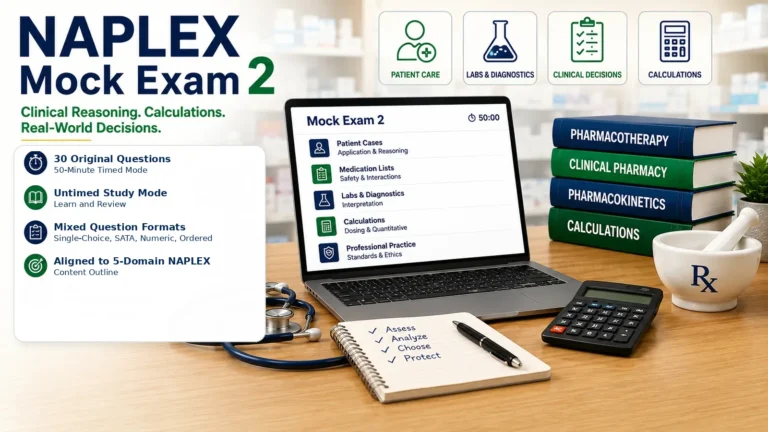
Take the Free NAPLEX Mock Exam, then use SCORE → SORT → STUDY → SOLVE → SIMULATE to turn every important miss into a targeted study decision.
You can also browse all Free Practice Exams.
The Free NAPLEX Mock includes 30 original questions with clinical reasoning and calculations, Timed and Study modes, and detailed rationales.
Do not simply look at the final percentage.
Run the exam through the five stages.
Create your error table.
Identify your most valuable weaknesses.
Turn each important mistake into a one-line rule.
Then prove that the weakness has actually been repaired.
Need a More Structured NAPLEX Study System?
Explore RxBoardPrep NAPLEX Prep for guided content review, calculations practice, clinical reasoning, and realistic practice exams built around deliberate review and remediation.
Final Takeaway
The purpose of a NAPLEX mock exam is not simply to tell you whether you got enough questions right.
Its real value is showing you what happens when your:
- knowledge
- calculations
- clinical reasoning
- interpretation
- reading
- pacing
are tested together.
Use the RxBoardPrep 5S Method:
SCORE
Capture what happened.
SORT
Identify why each important error happened.
STUDY
Repair the exact knowledge or reasoning gap.
SOLVE
Prove the repair using a new question.
SIMULATE
Prove it again later under mixed and timed conditions.
The mock itself may take a few hours.
But the review can influence everything you study afterward.
That is where much of its educational value comes from.
Frequently Asked Questions
Should I review every question on a NAPLEX mock exam?
Review every important uncertainty, but not every question needs equal time. Correct, high-confidence questions usually need only a quick check. Incorrect high-confidence answers, repeated weaknesses, calculation errors, and low-confidence correct answers deserve deeper review.
Is my mock-exam percentage a reliable prediction of passing NAPLEX?
A third-party mock percentage should not be treated as a direct conversion to a NAPLEX outcome. Practice resources can differ in difficulty, content mix, question style, and scoring. Track performance trends, weak areas, reasoning quality, pacing, and repeated errors alongside the raw score.
Should I review questions I guessed correctly?
Yes. A guessed correct answer can hide a knowledge gap. Mark low-confidence correct answers and verify that you can answer a different question testing the same concept.
How soon should I retest a missed concept?
Understand the issue during the initial review, solve a related new problem within roughly a day, and then let the concept reappear in mixed practice over the next several days.
What is the best way to review a NAPLEX calculation error?
Compare your original setup with the correct setup and locate the first point where they differ. Classify the issue as concept, setup, input selection, units, arithmetic, rounding, or pacing.
How should I review SATA questions?
Review every option independently. Determine why each statement is correct or incorrect instead of memorizing the final combination of selected choices.
How many mock exams should I take?
There is no universally correct number. The useful cycle is Mock → Review → Repair → Retest → Mock. Taking more exams without repairing the weaknesses uncovered by previous exams adds volume without necessarily adding learning.
What if my mock score drops?
Compare the exam content, difficulty, fatigue, pacing, and your error profile before drawing conclusions. One score can move for many reasons. Look for patterns across multiple comparable practice sessions rather than reacting to one result.
More NAPLEX Resources
Build daily quantitative skill with the NAPLEX Calculations 4-Week Practice Plan.
Continue with the rest of the RxBoardPrep NAPLEX and FPGEE study guides.
If you are comparing preparation options, you can also review course pricing.
Sources and Methodology
Official source: National Association of Boards of Pharmacy. NAPLEX Content Outline, effective for NAPLEX examinations beginning May 1, 2025. Official PDF
The current outline identifies five major content domains with approximate exam weights of 25%, 25%, 40%, 5%, and 5%.
RxBoardPrep internal evidence: NAPLEX 2026 — Student Insights & Course Blueprint, an internal synthesis of more than 130 student-reported NAPLEX experiences collected January–June 2026. Student recollections are used to identify recurring preparation challenges and study patterns, not to predict specific live examination content.
The 5S review framework and error-classification system in this article are RxBoardPrep educational methods intended to help students organize practice-exam review and remediation.
RxBoardPrep is an independent pharmacy education platform and is not affiliated with or endorsed by NABP. NAPLEX is a registered trademark of the National Association of Boards of Pharmacy.