NAPLEX Calculations: A 4-Week Practice Plan to Build Speed and Accuracy
Calculations are one of the easiest NAPLEX areas to study incorrectly.
A student may spend hours memorizing equations and still struggle when a question presents a patient weight in pounds, two concentrations, an unnecessary laboratory value, and asks for the final answer in a different unit.
The arithmetic is usually not the hardest part.
The real challenge is deciding:
- What is the question actually asking?
- Which information matters?
- Which formula or relationship applies?
- Which weight should be used?
- Which units must cancel?
- Does the final answer make clinical sense?
That is why NAPLEX calculation preparation should not be a one-week “math chapter.” It should be a daily skill practiced throughout your preparation.
The current NABP NAPLEX Content Outline specifically includes pharmaceutical calculations within Foundational Knowledge for Pharmacy Practice. Its calculation content spans patient and laboratory measures, drug quantities, administration rates, dose conversions, concentrations, compounding, nutrition, biostatistical measures, and pharmacokinetic parameters. For the full domain-by-domain breakdown, see our guide to the 2026 NAPLEX Content Outline.
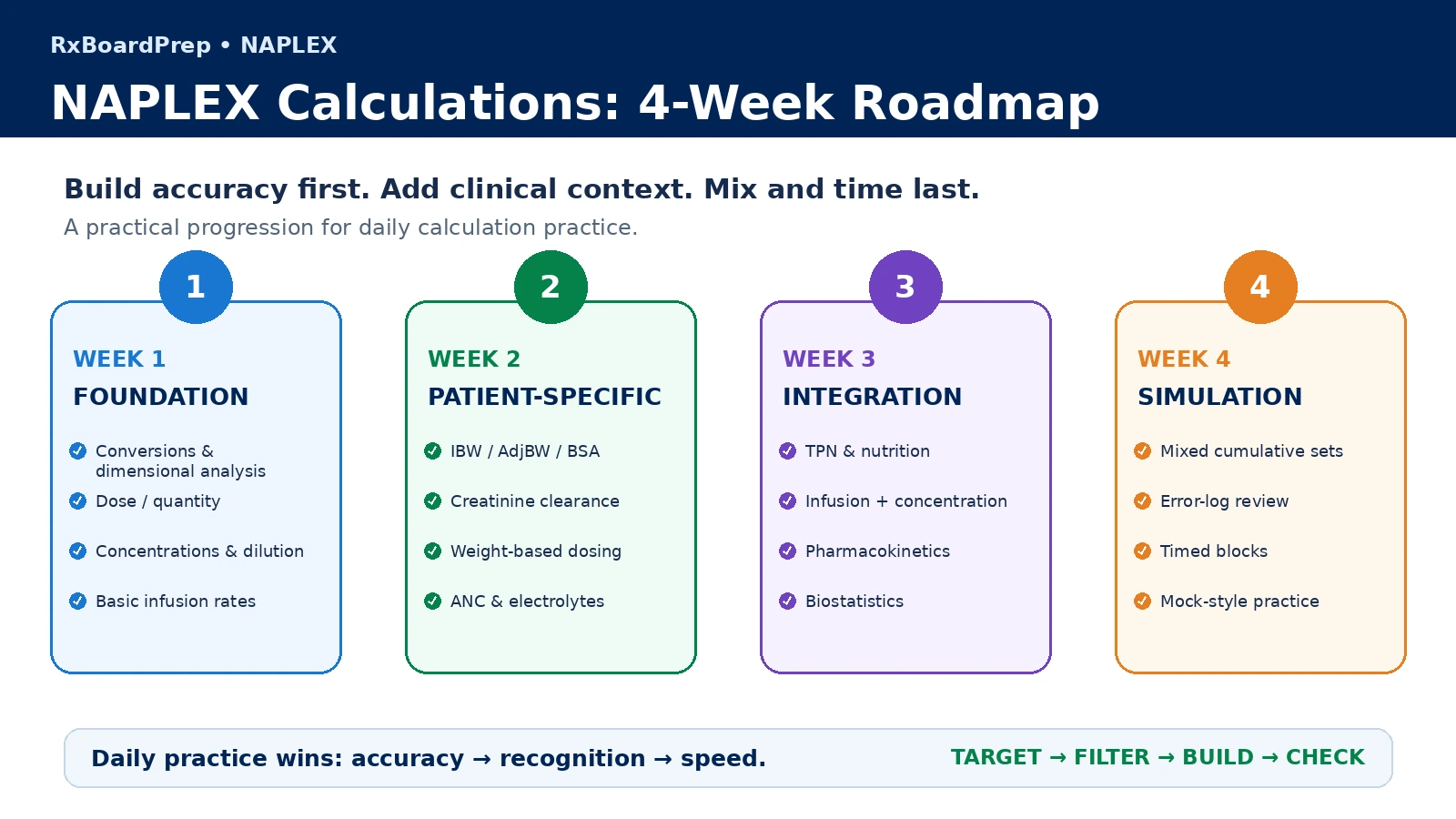
A practical way to cover that breadth is to build calculations in layers over four weeks.
The Mistake: Learning Formulas Before Learning Setups
Consider two students.
Student A memorizes 40 formulas.
Student B learns 20 formulas but solves problems every day, tracks unit errors, recognizes when body weight matters, and practices deciding which equation applies before touching the calculator.
Student B is usually better prepared for an exam-style calculation.
Why?
Because a calculation question actually contains several separate tasks:
Interpret → Set up → Calculate → Check
An error at any one of those stages produces the wrong answer.
A useful calculation plan therefore has to train all four.
Your 4-Week NAPLEX Calculations Plan
The four weeks have different purposes:
| Week | Main Goal | What Changes |
|---|---|---|
| Week 1 | Build clean fundamentals | Accuracy before speed |
| Week 2 | Apply calculations clinically | Patient data + dosing + labs |
| Week 3 | Handle complex/multistep calculations | Nutrition, PK, biostats, mixed problems |
| Week 4 | Perform under exam conditions | Timed, mixed, cumulative practice |
The goal is not to finish one category and forget it.
Every week should contain some cumulative review from the weeks before it.
Before Week 1: Build Your Calculation Error Log
Do this before solving hundreds of questions.
Create five columns:
| Question | Topic | Why I Missed It | Correct Setup | Rule to Remember |
|---|---|---|---|---|
| #14 | CrCl | Used the wrong patient weight | CG equation with appropriate weight | Decide the required weight before plugging in numbers |
| #22 | Infusion | Forgot min → hr conversion | 120 min ÷ 60 | Units must cancel |
| #31 | TPN | Converted protein to nitrogen incorrectly | Protein g ÷ 6.25 | Protein is not nitrogen |
This changes how you review.
Instead of writing:
“I got TPN wrong.”
you identify the actual problem:
“I knew the formula but converted protein to nitrogen incorrectly.”
Those are very different weaknesses.
Use Five Error Categories
Mark every missed calculation as one of these:
- Concept error: You did not know what the question was testing.
- Setup error: You knew the concept but selected the wrong equation or data.
- Unit error: mg vs g, mL vs L, hours vs minutes, lb vs kg, etc.
- Arithmetic error: The setup was correct but the calculation was wrong.
- Pacing error: You could solve it, but it took too long.
By Week 4, your goal is not simply to increase your percentage.
It is to eliminate entire types of errors.
Week 1 — Build the Calculation Foundation
Goal: Make basic setups automatic
Do not begin with the hardest TPN or pharmacokinetic problem you can find.
First make the fundamental relationships fast and reliable.
Topics to Emphasize
1. Unit Conversions
Become comfortable moving between:
- kg and lb
- g, mg, mcg
- L and mL
- hours and minutes
- percentages and decimals
- units and concentrations
A surprising number of “difficult” calculations become easy once the units are organized correctly.
The Dimensional-Analysis Habit
Write units throughout the calculation.
For example:
A patient weighs 176 lb.
Convert to kg:
176 lb × 1 kg / 2.2 lb = 80 kg
The pounds cancel.
That visual cancellation protects you from many errors.
2. Dose and Quantity Calculations
Practice questions asking:
- How many tablets?
- How many milliliters?
- How many milligrams per dose?
- How much drug is administered over 24 hours?
- How much product should be dispensed?
- How long will the supply last?
Example
An oral suspension contains 250 mg/5 mL.
The prescribed dose is 375 mg.
375 mg × 5 mL / 250 mg = 7.5 mL
Do not memorize this as a special suspension formula.
Think:
I have mg. I need mL. What conversion factor connects them?
That mindset transfers to harder problems.
3. Percent Strength, Ratio Strength, and Concentrations
Practice moving among:
- % w/v
- % v/v
- % w/w
- mg/mL
- g/mL
- ratio strength
- dilution relationships
You should recognize quickly that:
1% w/v = 1 g/100 mL = 10 mg/mL
But understanding the relationship is more useful than memorizing isolated conversions.
4. Dilutions
Know how to use relationships such as:
C1V1 = C2V2
But first ask:
Is this actually a dilution problem?
Do not automatically use C1V1 = C2V2 every time two concentrations appear.
5. Alligation
Know both:
- how to perform the setup
- why the ratio works
Then practice translating the ratio into actual quantities.
That second step is where many students stop too early.
6. Basic Infusion-Rate Calculations
Practice:
- mL/hr
- infusion duration
- dose per time
- gtt/min when a drop factor is provided
Example
A 500-mL infusion must run over 4 hours.
500 mL ÷ 4 hr = 125 mL/hr
Simple—but later questions may combine this with drug concentration, patient weight, or dose per minute.
Week 1 builds the base for those multistep problems.
Week 1 Daily Schedule
Use approximately 30–45 minutes per day.
- Days 1–2: Conversions + dimensional analysis
- Day 3: Dose/quantity + days supply
- Day 4: Percent strength + concentrations
- Day 5: Dilutions + alligation
- Day 6: Basic infusion calculations
- Day 7: 25–30 mixed questions from everything above
Do not study formulas on Day 7.
Solve.
Week 2 — Add the Patient
Week 1 asks:
Can you calculate?
Week 2 asks:
Can you calculate using the correct patient information?
This is where NAPLEX-style problems become more clinically meaningful.
1. Body-Weight Calculations
Know how to calculate and recognize when a problem may require:
- Actual body weight
- Ideal body weight
- Adjusted body weight
- Body surface area
The calculation itself is only half the skill.
The other half is selecting the appropriate weight for the specific patient, drug, equation, or problem being tested.
Make this a habit:
Before entering numbers into an equation, write:
Weight being used = ______
That one line prevents many mistakes.
2. Creatinine Clearance
Do not practice Cockcroft-Gault as a formula-only exercise.
Practice cases that force you to decide:
- Which patient weight is appropriate for the particular problem?
- Is the serum creatinine provided?
- Is age relevant?
- Does sex change the equation?
- What does the resulting renal function mean for the medication question?
The calculation may only be Step 1.
Step 2 may ask whether a drug dose is appropriate at that renal function.
3. Weight-Based Dosing
Practice questions involving:
- mg/kg/dose
- mg/kg/day
- divided doses
- maximum doses
- dose caps
A Common Trap
A regimen says:
15 mg/kg/day divided every 8 hours
That is not the same as:
15 mg/kg every 8 hours
Slow down long enough to identify whether the number is:
- per dose
- per day
- per kg
- or some combination
before calculating.
4. Body-Surface-Area Dosing
Practice converting a BSA-based recommendation into an actual patient dose.
Then reverse the problem:
If the patient received a certain dose, what mg/m² dose did that represent?
Exam questions can run either direction.
5. Corrected Laboratory Values
Practice interpreting and calculating commonly used corrections rather than merely recognizing their names.
Examples can include:
- corrected calcium
- corrected phenytoin
- other patient-specific adjustments when the necessary data are provided
Even when a formula is available on an exam reference resource, you still need to recognize when it applies and use the correct patient values.
6. Absolute Neutrophil Count
Know the structure:
ANC = WBC × (% neutrophils + % bands) / 100
But also practice CBC presentations where the terms are not arranged perfectly for you.
The calculation is simple.
Finding the correct inputs is the skill.
7. Electrolyte Calculations
Practice conversions involving:
- mEq
- mmol
- electrolyte concentrations
- quantities delivered in IV products
These calculations become especially important when combined with parenteral nutrition or IV replacement.
Week 2 Daily Schedule
- Day 8: IBW, AdjBW, BSA
- Day 9: Creatinine clearance
- Day 10: Weight-based dosing
- Day 11: Renal dosing cases
- Day 12: Corrected laboratory values + ANC
- Day 13: mEq, mmol, electrolyte conversions
- Day 14: 30 mixed Week 1 + Week 2 calculations
Now begin timing yourself.
Not aggressively.
Just record how long each problem takes.
Week 3 — Master the Multistep Problems
This is the week where calculations begin to resemble the problems students often find intimidating.
In RxBoardPrep’s review of more than 130 recent NAPLEX test-taker reports, calculations were one of the most repeatedly emphasized preparation areas. Nutrition/TPN, infusion rates, electrolyte conversions, renal calculations, pharmacokinetics, corrected values, body-weight calculations, and biostatistical measures appeared repeatedly in those reports.
Student recollections cannot predict an individual exam, but they support making calculations a continuous—not last-minute—part of preparation.
1. Parenteral Nutrition / TPN
Do not reduce TPN to “memorize the calories.”
Break it into components.
Practice calculating:
Dextrose Calories
3.4 kcal/g
Amino-Acid/Protein Calories
4 kcal/g
Lipid Calories
Use the caloric value appropriate to the specific lipid product and concentration provided in the problem or reference material rather than assuming a single universal lipid calorie value.
Then practice:
- total calories
- calories/kg/day
- grams of protein
- grams of nitrogen
- nonprotein calories
- nonprotein calorie:nitrogen ratio
- fluid contribution
- electrolyte contribution
- infusion rate
The Key Upgrade
Do not always practice TPN as a clean standalone math problem.
Use patient cases.
For example:
The patient’s potassium is elevated. Which component of the nutrition order deserves attention?
That requires calculation plus clinical interpretation.
2. Infusion Calculations With Drug Concentration
Progress from:
mL/hr
to:
mg/hr
then:
mg/kg/hr
then:
mcg/kg/min
These problems become much easier if you let the units guide you.
The Rule
Write the unit you want at the far right:
mcg/kg/min
Then build conversion factors until everything else cancels.
3. Osmolarity and Osmolality
Know the conceptual distinction as well as the arithmetic.
A question may ask you to:
- calculate a value
- compare solutions
- determine whether a product meets a condition
- interpret what the number means
A mathematically correct value without the correct interpretation can still lead to the wrong answer.
4. Pharmacokinetics
Build from core relationships such as:
- elimination-rate constant
- half-life
- volume of distribution
- clearance
- loading dose
- maintenance concepts
- concentration changes over time
- first-order vs zero-order behavior
Example relationship:
t½ = 0.693 / k
Do not stop at solving for t½.
Practice rearranging equations.
If the question gives the half-life and asks for k, you should be equally comfortable moving backward.
5. Biostatistics Calculations
The official NAPLEX calculation framework also includes biostatistical, epidemiological, and pharmacoeconomic measures.
Practice calculations such as:
- Absolute risk
- Absolute risk reduction
- Relative risk
- Relative risk reduction
- Number needed to treat
- Number needed to harm
- Odds ratio
- Other measures when sufficient data are provided
Do Not Separate Calculation From Interpretation
If:
RR = 0.70
you should not merely know that the number is below 1.
You should understand what it means in the context of the event being measured.
That interpretation is often more important than the arithmetic.
Week 3 Daily Schedule
- Day 15: Nutrition fundamentals
- Day 16: TPN calories + nitrogen
- Day 17: TPN + electrolytes + infusion rates
- Day 18: Pharmacokinetics
- Day 19: Biostatistics calculations
- Day 20: Mixed multistep problems
- Day 21: 40-question calculation block
At this stage, calculate your:
- overall accuracy
- average time per question
- most common error category
Week 4 — Stop Practicing by Chapter
During the first three weeks you often knew the topic before starting.
That changes now.
The final week should be mostly mixed practice.
A real exam does not announce:
This is an alligation question.
You have to recognize it.
That recognition is part of the test.
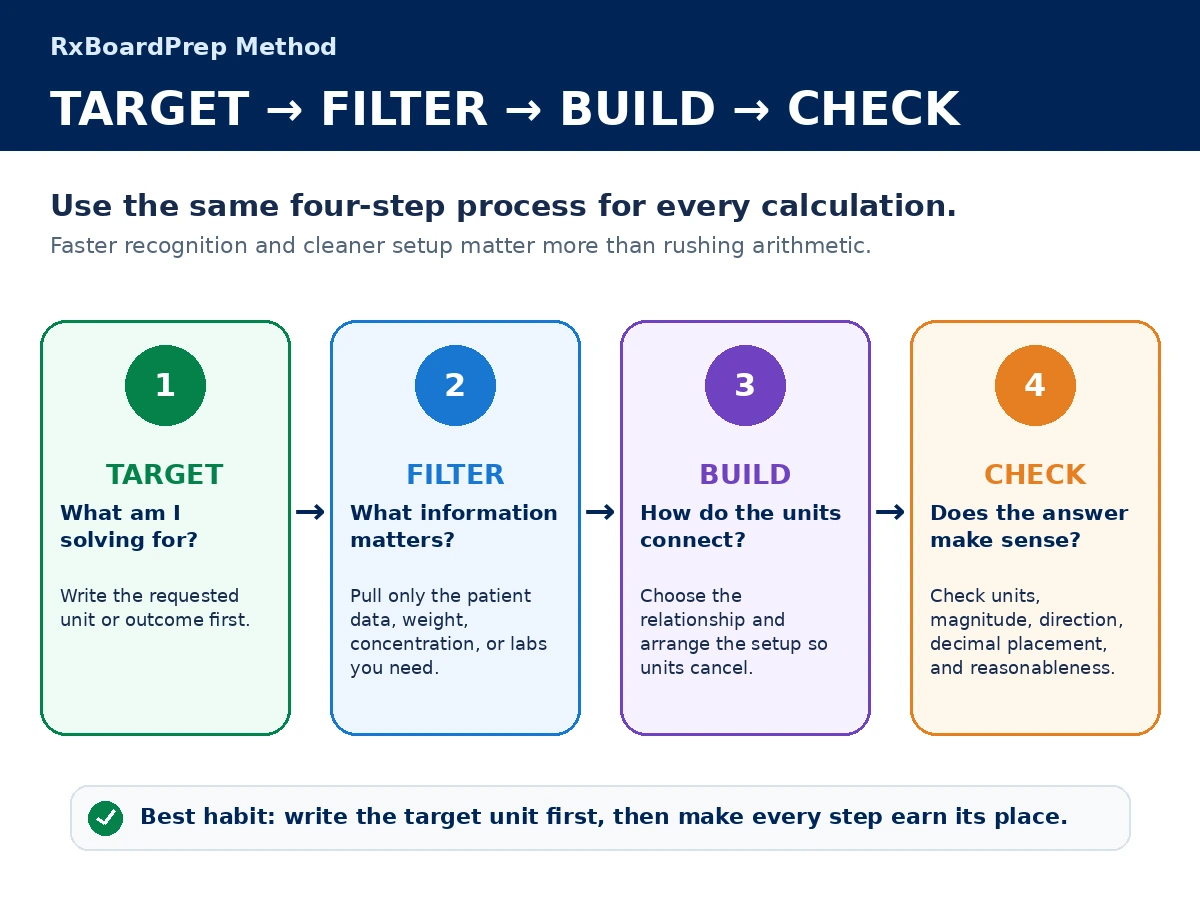
The RxBoardPrep 4-Step Calculation Method
For every calculation, use the same sequence.
Step 1 — TARGET
Write what the question wants.
Examples:
Target = mL/hr
Target = mg/dose
Target = CrCl in mL/min
Target = kcal/day
Do this before touching the calculator.
Step 2 — FILTER
Separate needed information from distracting information.
Ask:
- Which patient values matter?
- Which weight matters?
- Is one laboratory value irrelevant?
- Is a concentration already provided?
- Is there a maximum dose?
Do not assume every number in the case belongs in your equation.
Step 3 — BUILD
Set up the calculation so the units cancel.
Whenever possible, avoid jumping immediately to mental arithmetic.
A visible setup lets you catch mistakes before they become final answers.
Step 4 — CHECK
Before submitting, ask:
- Unit check: Is the answer in the requested unit?
- Magnitude check: Is this number clinically plausible?
- Direction check: Should this value be larger or smaller than the starting value?
- Decimal check: Could a misplaced decimal have created a 10-fold or 100-fold error?
This final check should take seconds—not minutes.
Week 4 Daily Schedule
- Day 22: 20 mixed questions — untimed. Focus on clean recognition and setup.
- Day 23: 25 mixed questions — timed
- Day 24: 30 mixed questions — timed
- Day 25: Review your error log only. Do not reread an entire calculation textbook. Review the mistakes you actually make.
- Day 26: 30 new mixed questions
- Day 27: Calculation-heavy mock block. Mix calculations with clinical questions so you have to switch thinking styles.
- Day 28: Final readiness check. Solve a fresh mixed set and compare it with Week 1.
Look at:
- accuracy
- speed
- setup errors
- unit errors
- careless errors
- confidence
How Fast Should You Be?
Do not chase a fixed number of seconds for every problem.
Some calculation questions genuinely require several steps. Others should be nearly automatic.
A better goal is:
Spend less time deciding how to start.
That is where fluency shows up.
A student who immediately recognizes:
“This is a concentration → dose → infusion-rate problem”
has a major advantage over someone who spends two minutes searching through memorized formulas.
The 60-Second Rule for Being Stuck
If you have stared at a calculation for about a minute and have not meaningfully advanced:
Do not keep punching random numbers into the calculator.
Reset.
Write:
- What am I solving for?
- What units do I need?
- Which data connect what I have to what I need?
Often the pathway becomes obvious.
The worst response to confusion is uncontrolled arithmetic.
Should You Memorize Every Formula?
No.
But you should know the high-frequency relationships well enough that formula recall does not become the bottleneck.
More importantly, you must understand how to use them.
There are three levels:
Level 1 — Recognition
“I remember this equation.”
Level 2 — Application
“I know which patient values belong in it.”
Level 3 — Interpretation
“I understand what the answer means clinically.”
NAPLEX preparation should reach Level 3 whenever possible.
A Better Way to Use a Formula Sheet
Do not read a formula sheet from top to bottom every night.
Instead:
Cover the formula
Ask:
What problem would make me use this?
Then reverse it.
Look at a problem and ask:
Which relationship does this require?
The second skill is the one you need on exam day.
The Most Important Calculation Topics to Rotate
Based on the official NAPLEX calculation categories and recurring themes in RxBoardPrep’s recent student-report review, a strong cumulative practice bank should include:
| Calculation Cluster | Examples |
|---|---|
| Basic pharmacy math | conversions, proportions, concentrations, quantity |
| Compounding | percent strength, ratio strength, dilution, alligation |
| Administration | mL/hr, infusion time, gtt/min, dose rates |
| Patient parameters | IBW, AdjBW, BSA, CrCl, ANC, corrected values |
| Electrolytes | mEq, mmol, concentrations |
| Nutrition | dextrose, protein, lipids, calories, nitrogen, TPN |
| Pharmacokinetics | half-life, k, Vd, clearance, dosing concepts |
| Evidence calculations | ARR, RRR, RR, NNT, NNH, OR |
| Mixed clinical math | dosing adjustment, labs + calculation + therapeutic decision |
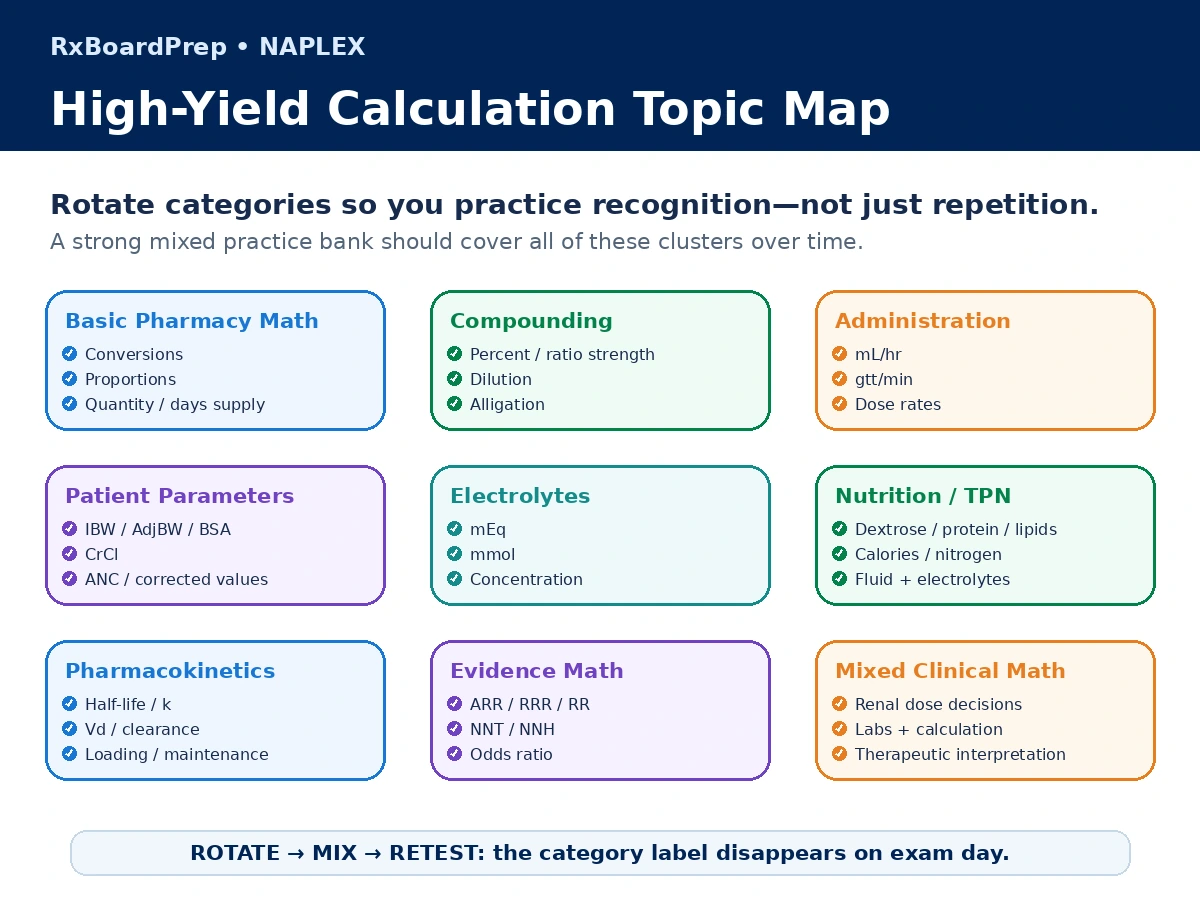
Do not study these once.
Rotate them.
What Your Final Week Should NOT Look Like
Avoid this:
Monday: 50 CrCl questions
Tuesday: 50 alligation questions
Wednesday: 50 TPN questions
That creates artificial pattern recognition.
By the 10th CrCl question, you know the formula before you read the stem.
Instead, mix:
- CrCl
- TPN
- infusion
- concentration
- PK
- biostatistics
- a non-calculation clinical question
- then another calculation
That forces your brain to identify the problem rather than simply repeat yesterday’s setup.
How to Review a Wrong Calculation
Never stop at the correct answer.
Use this five-question review:
- Did I recognize the calculation type correctly?
- Did I choose the correct patient data?
- Was my equation/setup correct?
- Did my units cancel correctly?
- Was the error mathematical or conceptual?
Then solve it again without looking at the explanation.
If you cannot reproduce the solution independently, you have not finished reviewing it.
The 24-Hour Retest Rule
Whenever you miss an important calculation:
- Review it today.
- Solve a similar problem tomorrow.
- Solve the concept again several days later inside a mixed set.
That is much more powerful than immediately doing the same problem five times.
Immediate repetition can create familiarity without durable learning.
When Are You Actually Ready?
Do not judge calculation readiness by saying:
“I finished the calculations chapter.”
Instead ask:
- Can I recognize the calculation type without a chapter heading?
- Can I select the correct patient values?
- Can I keep units organized?
- Can I solve common calculations without repeatedly looking up the setup?
- Can I handle calculations after 30–40 unrelated questions?
- Can I recover quickly when a problem looks unfamiliar?
- Are my errors becoming rare and identifiable rather than random?
That is readiness.
Put the Plan Into Practice
Reading a calculation solution can make a problem feel easy.
Solving it yourself is different.
After building the fundamentals, test whether you can identify calculation problems when they are mixed with therapeutics, medication safety, and patient cases.
Ready to test the process?
Try the Free NAPLEX Mock Exam and use your missed questions to identify calculation, clinical-reasoning, and pacing weaknesses.
You can also browse all free practice exams.
The free NAPLEX mock includes 30 original questions with calculations and clinical reasoning, Timed and Study modes, and detailed rationales.
Use it as an application check—not merely as a score.
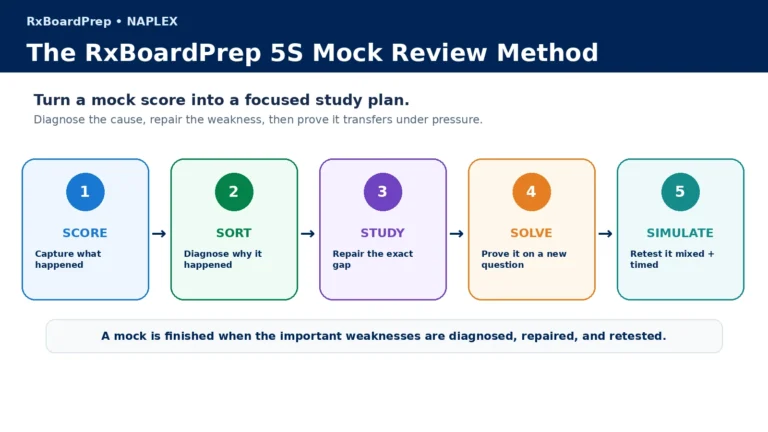
After the exam, classify every missed calculation using the error log from this article:
Concept → Setup → Unit → Arithmetic → Pacing
Then decide what your next week of practice should target.
If Calculations Are Your Weakest Area
Do not respond by spending your entire NAPLEX preparation period on math.
Calculations matter, but the current NAPLEX blueprint remains broad. Foundational Knowledge represents approximately 25% of scored questions, while Person-Centered Assessment and Treatment Planning is the largest domain at approximately 40%.
The better strategy is:
Calculations every day + broader NAPLEX study every day.
That keeps quantitative skills sharp without sacrificing therapeutics, medication-use processes, patient assessment, safety, professional practice, or management.
Need a More Structured NAPLEX Study System?
Explore the RxBoardPrep NAPLEX Prep Course for guided content review, calculations practice, clinical reasoning, and realistic practice exams.
Final Takeaway
NAPLEX calculations should become a skill, not a chapter you completed.
Over four weeks:
- Week 1: Build clean fundamentals.
- Week 2: Add patient-specific data.
- Week 3: Master multistep calculations.
- Week 4: Mix everything and add time pressure.
And for every problem:
TARGET → FILTER → BUILD → CHECK
If your units are organized, your setup is deliberate, and your practice is cumulative, calculations become much less intimidating.
You stop asking:
“Which formula am I supposed to remember?”
and start asking:
“What does this problem need me to solve?”
That is the transition we want before exam day.
Frequently Asked Questions
Are calculations still tested on the current NAPLEX?
Yes. Pharmaceutical calculations are explicitly included in the current NABP Content Outline under Foundational Knowledge for Pharmacy Practice. The outline includes patient/laboratory measures, drug quantities, administration rates, dose conversions, concentrations, compounding quantities, nutrition, biostatistical/epidemiological/pharmacoeconomic measures, and pharmacokinetic parameters.
Should I practice NAPLEX calculations every day?
For most candidates, short daily practice is more useful than completing one large calculation block and then leaving the subject for weeks. Daily exposure helps maintain formula recognition, unit control, and speed.
What calculations should I prioritize for NAPLEX?
Build broad coverage first. High-value practice areas include dose and quantity calculations, concentrations and dilutions, infusion rates, patient-specific parameters such as renal function and body weight, electrolytes, nutrition/TPN, pharmacokinetics, and biostatistical measures.
Is TPN important for NAPLEX calculations?
Parenteral nutrition is included within the broader nutrition and pharmaceutical-calculation framework. It was also repeatedly mentioned in RxBoardPrep’s review of recent student experiences. That makes it a sensible area for substantial practice, but individual NAPLEX forms vary and no student report can predict exactly what will appear on yours.
Should I memorize every NAPLEX formula?
No. Memorize or become fluent with core relationships, but spend more time learning when and how to use them. Formula recognition without correct setup is not enough.
How can I become faster at calculations?
First remove setup and unit errors. Then add timed mixed practice. Speed built on a weak setup usually creates faster mistakes.
Should I use only calculation questions during the final week?
No. Mix calculations with clinical and non-calculation questions. This forces you to recognize the problem type yourself and better reflects the mental switching required during a broad licensure examination.
What should I do when I miss the same type of calculation repeatedly?
Identify the reason for the miss—concept, setup, units, arithmetic, or pacing—then practice a similar problem after a delay. Repeatedly rereading the same worked example can create familiarity without independent mastery.
More NAPLEX Resources
Continue with the rest of the RxBoardPrep NAPLEX and FPGEE study guides.
If you are comparing preparation options, you can also review course pricing.
Sources and Methodology
Official source: National Association of Boards of Pharmacy. NAPLEX Content Outline, effective for examinations beginning May 1, 2025. Official PDF
RxBoardPrep internal evidence: NAPLEX 2026 — Student Insights & Course Blueprint, an internal synthesis of more than 130 student-reported NAPLEX experiences collected January–June 2026. Student recollections were used to identify recurring preparation challenges, not to predict specific examination content.
RxBoardPrep is an independent pharmacy education platform and is not affiliated with or endorsed by NABP. NAPLEX is a registered trademark of the National Association of Boards of Pharmacy.