2026 NAPLEX Content Outline Explained: 5 Domains, Weights, and Student-Reported Priorities
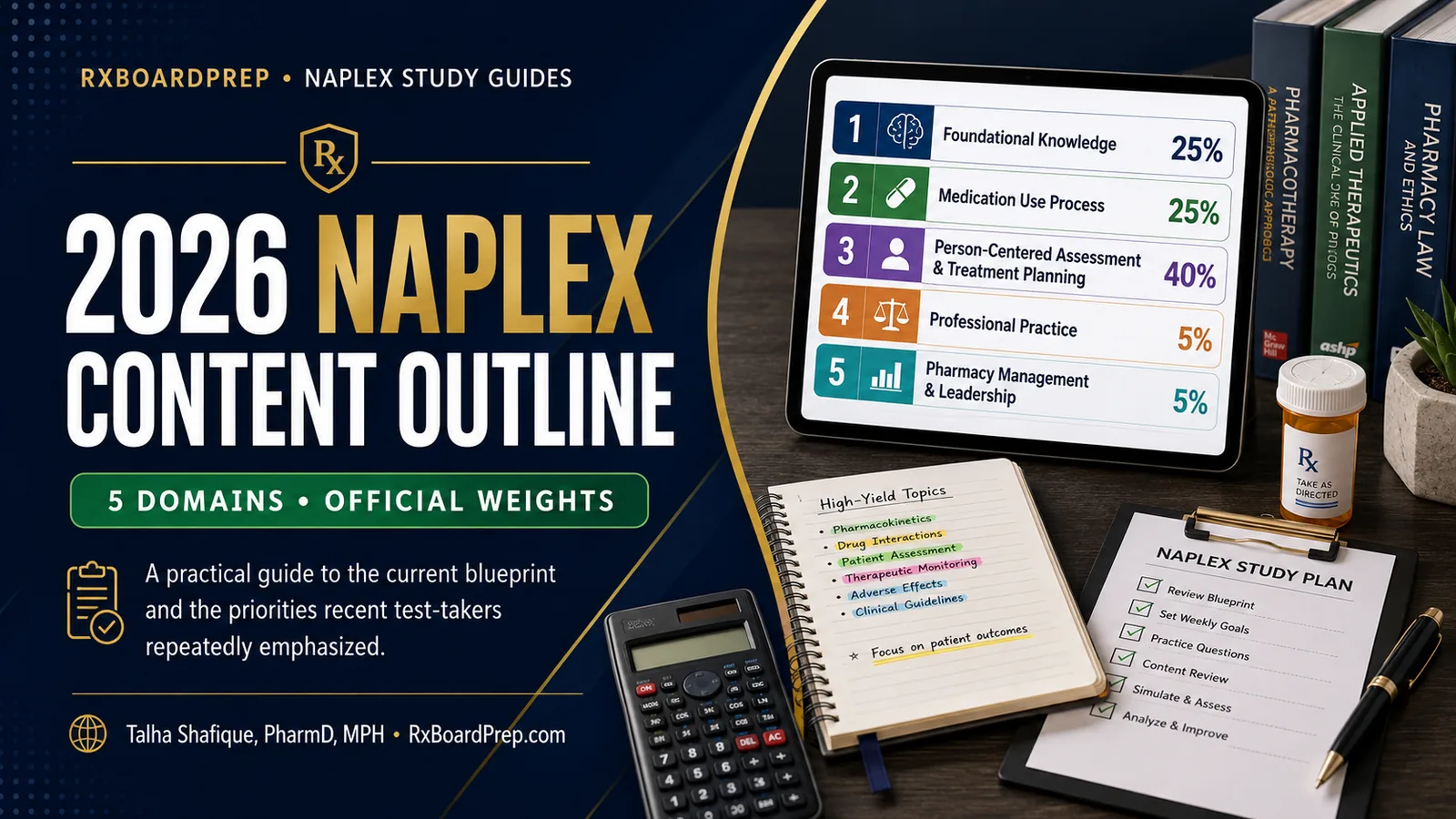
Quick answer: The current NAPLEX Content Outline contains five domains. Foundational Knowledge for Pharmacy Practice and Medication Use Process each account for approximately 25% of scored questions. Person-Centered Assessment and Treatment Planning accounts for approximately 40%. Professional Practice and Pharmacy Management and Leadership each account for approximately 5%.
The NAPLEX is not organized like a traditional therapeutics textbook. Cardiology, infectious diseases, diabetes, oncology, calculations, immunizations, compounding, and pharmacy operations all matter, but the official blueprint organizes them according to the knowledge and decisions expected from an entry-level pharmacist.
That difference is important. A student may remember the preferred medication for a disease and still miss a question because the dose is inappropriate, the patient has a contraindication, the order is incomplete, the monitoring plan is unsafe, or the best response involves medication-use workflow rather than selecting another drug.
The current NAPLEX Content Outline applies to examinations beginning May 1, 2025 and remains the framework used by candidates testing in 2026. The exam contains 225 questions and is administered over six hours. The domain percentages are based on approximately 200 scored questions.
The five NAPLEX domains at a glance
| Domain | Official content domain | Weight | Approximate scored questions |
|---|---|---|---|
| 1 | Foundational Knowledge for Pharmacy Practice | 25% | About 50 |
| 2 | Medication Use Process | 25% | About 50 |
| 3 | Person-Centered Assessment and Treatment Planning | 40% | About 80 |
| 4 | Professional Practice | 5% | About 10 |
| 5 | Pharmacy Management and Leadership | 5% | About 10 |
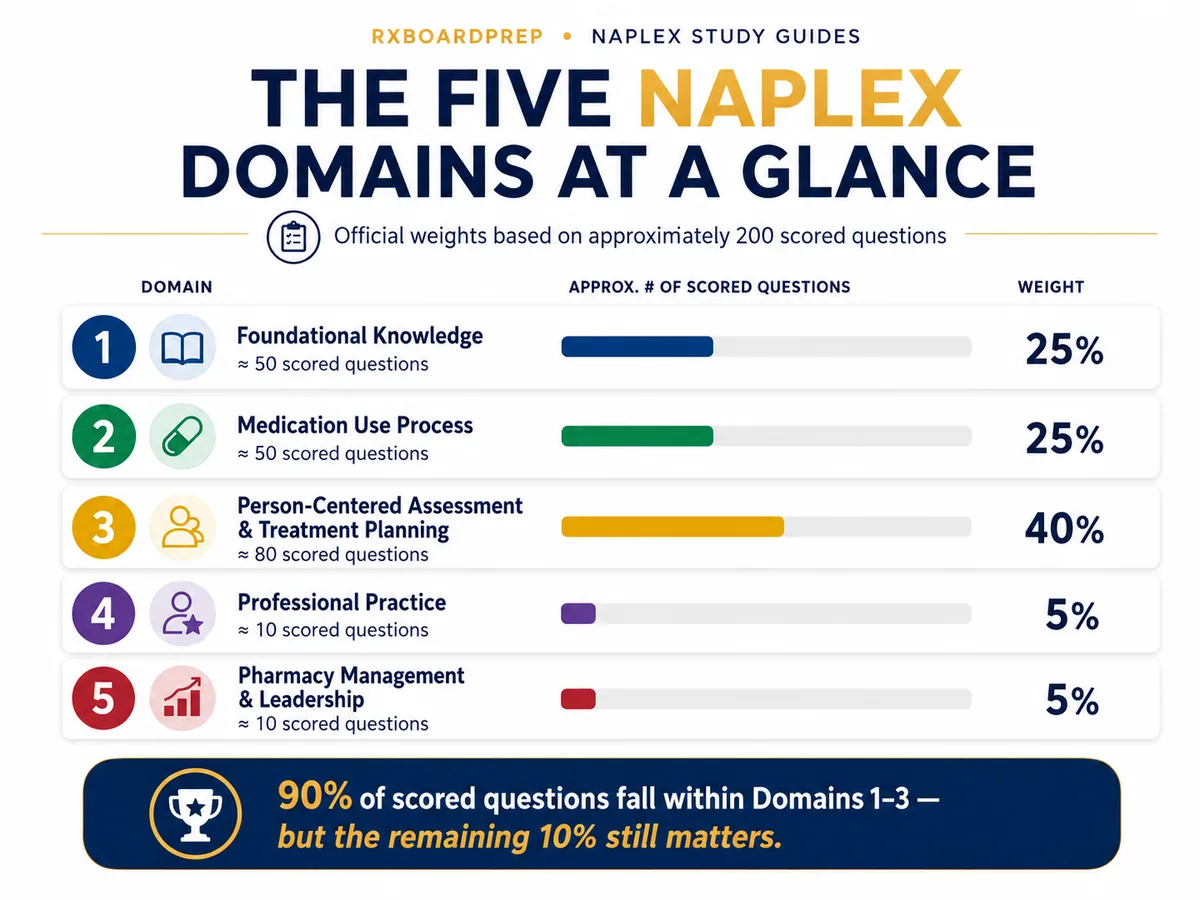
These percentages are the best starting point for planning your study time, but they are not a promise that every candidate will remember the same number of questions from every topic. Different exam forms can feel very different.
Domain 1: Foundational Knowledge for Pharmacy Practice — 25%
This domain supplies the scientific and quantitative foundation needed to make safe pharmacy decisions. It includes pharmacology, pharmacokinetics, pharmacodynamics, pharmacogenomics, pharmaceutics, sterile and nonsterile compounding, pharmaceutical calculations, drug development, research design, biostatistics, and literature evaluation.
The key mistake is treating Domain 1 as a list of formulas. On exam-style problems, the difficult part is often deciding which data, unit, equation, body weight, concentration, or clinical assumption should be used before performing the arithmetic.
Preparation focus: Practice calculations repeatedly, but also practice interpreting what the answer means. Review study design and biostatistics as concepts, not just equations. A correct number paired with an incorrect clinical interpretation is still an incorrect response.
Domain 2: Medication Use Process — 25%
Domain 2 covers what happens between deciding on a therapy and safely delivering it to the patient. It includes prescription and medication-order interpretation, drug names and therapeutic classes, indications and dosing regimens, dosage forms, therapeutic and biosimilar substitutions, immunization services, documentation, administration, monitoring, storage, handling, stability, and disposal.
This domain is commonly underestimated because its content is spread across many chapters. Students may study the clinical indication but forget the dosage form, reconstitution requirement, storage condition, administration technique, substitution issue, or documentation step.
Preparation focus: For every major medication, ask more than “What is it used for?” Also ask how it is ordered, prepared, administered, stored, substituted, monitored, and documented.
Domain 3: Person-Centered Assessment and Treatment Planning — 40%
This is the largest domain and the clinical center of the exam. It includes medication reconciliation, health histories, screening, patient assessment, special populations, therapy appropriateness, interactions, medication-related problems, adverse reactions, toxicology, adherence, monitoring, patient education, self-care, dietary supplements, and medication or self-monitoring devices.
Domain 3 is not simply a test of first-line treatment. A strong response often requires combining the disease state with age, pregnancy, kidney or liver function, laboratory values, allergies, drug interactions, adherence, cost, administration ability, and follow-up needs.
Preparation focus: Train yourself to move through a repeatable sequence: identify the immediate problem, decide whether current therapy is indicated and effective, check safety and interactions, account for patient-specific factors, and choose the best next action—not merely an acceptable action.
Domain 4: Professional Practice — 5%
This domain includes adverse-event and medication-error reporting, public-health and risk-prevention programs, social drivers of health, ethical principles, informed consent, confidentiality, professional conduct, and responsibility.
Five percent may appear small, but leaving the entire domain unreviewed gives away avoidable points. These questions can also be difficult because several answer choices may sound compassionate or reasonable while only one best protects patient safety, autonomy, privacy, and professional duty.
Preparation focus: Use short scenarios. Ask what should be reported, what information may be shared, which barrier is affecting care, and what the pharmacist is responsible for doing next.
Domain 5: Pharmacy Management and Leadership — 5%
Domain 5 covers pharmacy operations, regulatory bodies, technology and informatics, risk management, medication safety, recalls, shortages, inventory, quality improvement, medication-use evaluation, root-cause analysis, delegation, feedback, mentorship, and precepting.
This is not merely business content. It tests whether the pharmacist can maintain a safe medication-use system. A workflow problem, inventory failure, technology alert, shortage, or communication breakdown can harm a patient even when the medication choice itself is correct.
Preparation focus: In operational cases, separate the immediate safety action from the long-term system improvement. Do not automatically choose punishment when the better answer is to identify contributing factors and redesign the process.
What more than 130 recent student reports add to the official outline
The official outline tells you what can be tested. Student experiences cannot predict an individual exam form, but repeated themes can reveal where candidates commonly struggle or underprepare.
RxBoardPrep reviewed a compiled set of more than 130 student-reported NAPLEX experiences collected from January through June 2026. Five patterns appeared repeatedly:
1. Broad coverage matters
Many students described the exam as wide-ranging and advised future candidates not to skip smaller chapters. The practical lesson is not to study every topic equally. It is to avoid leaving entire areas untouched because they appear less important.
2. Calculations and biostatistics require continuous practice
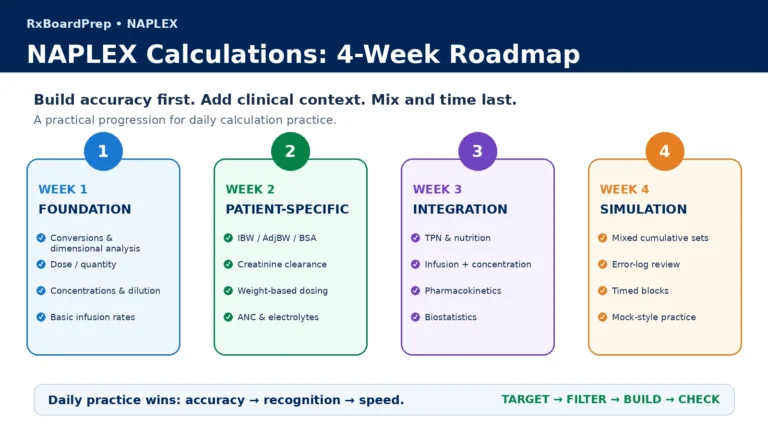
Calculations were the most consistently emphasized skill. Reports repeatedly mentioned nutrition calculations, infusion rates, electrolyte conversions, renal function, corrected values, pharmacokinetics, and measures such as NNT, NNH, ARR, RRR, relative risk, and odds ratios.
The larger lesson is simple: calculations should be practiced throughout preparation rather than saved for one intensive week.
3. Clinical questions reward structured case reading
Students frequently described indirect cases involving medication lists, interactions, abnormal laboratory values, adverse effects, monitoring, contraindications, and special populations. Knowing the disease chapter was not always enough; candidates also had to identify the most important clue and prioritize the safest next action.
4. Ethics, professional practice, and management are easy to underestimate
Although Domains 4 and 5 represent 10% combined, many students said these areas felt more noticeable than expected. Multiple-response questions were also often associated with ethics or management scenarios in the reports reviewed.
This does not mean the official weighting is wrong. It means a small domain can feel disproportionately difficult when a student has barely studied it.
5. Pacing is part of readiness
Several students reported spending too long on early questions and then feeling rushed. Others described questions as more indirect than expected even when the underlying topic was familiar.
Knowledge alone is not enough. Timed mixed practice should teach you when to calculate carefully, when to eliminate choices efficiently, and when to move forward rather than repeatedly second-guessing.
How to interpret student feedback responsibly: These reports identify recurring preparation themes. They do not guarantee an exact topic count, a specific number of multiple-response questions, or the content of any individual examination.
A simple three-layer NAPLEX study system
The most effective way to use the content outline is to combine three layers rather than choosing between “study the blueprint” and “study high-yield topics.”
Layer 1: Official domain coverage
Use the five domains as a completeness check. Every week should include foundational skills, medication-use workflow, clinical reasoning, and at least some professional-practice and management review.
Layer 2: Repeated skill practice
Practice calculations, biostatistics, drug information, medication-order interpretation, and case analysis continuously. These skills become slower and less reliable when they are studied once and then abandoned.
Layer 3: Timed mixed application
Chapter-specific questions are useful while learning. Mixed cases are necessary for readiness because the real challenge is identifying which knowledge applies when the topic is not announced in advance.
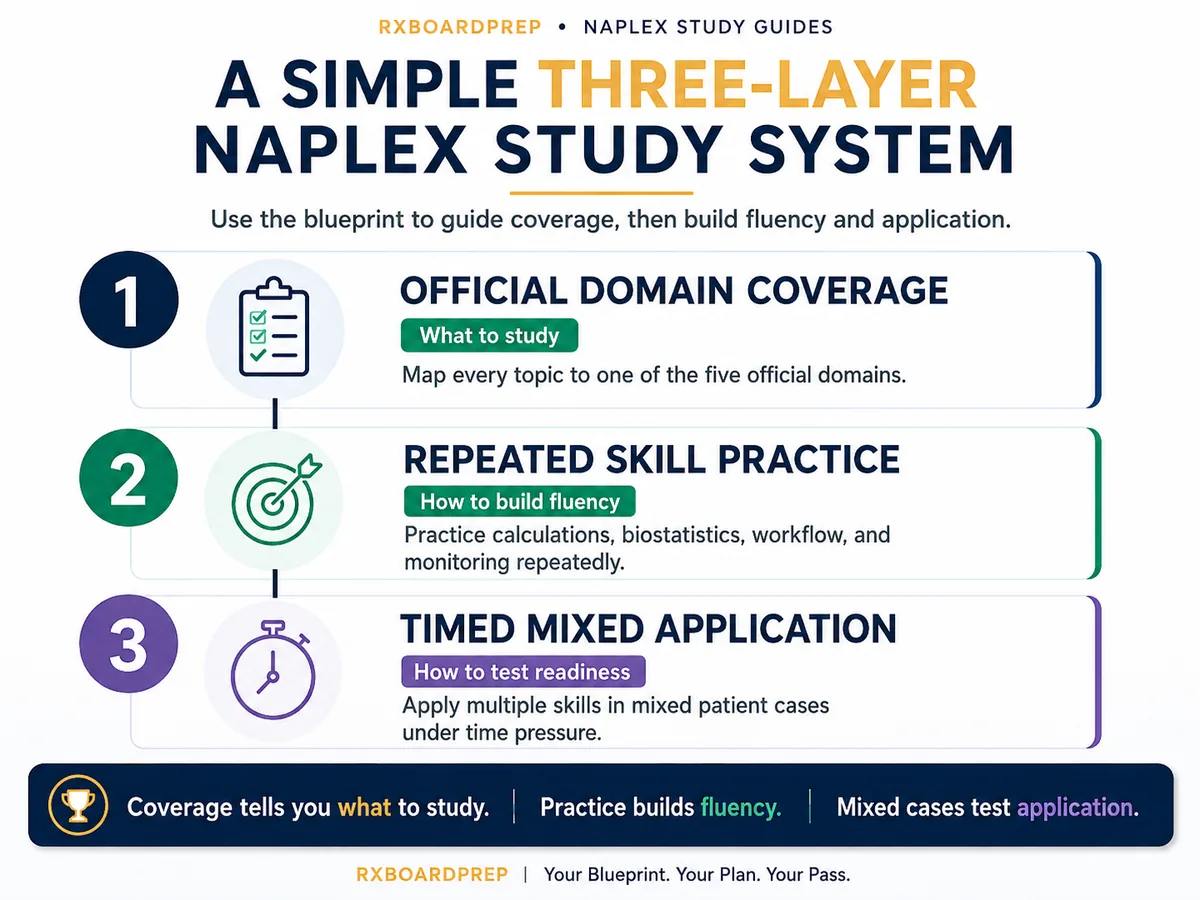
A reasonable starting point is to allocate study time close to the official weights—25%, 25%, 40%, 5%, and 5%—then adjust based on your performance. Do not permanently reduce Domain 3 because calculations are weak, and do not ignore Domains 4 and 5 because they are smaller.
Three preparation mistakes the blueprint can prevent
Mistake 1: Studying only disease-state chapters. This can leave gaps in calculations, compounding, medication-use workflow, research, reporting, shortages, and quality improvement.
Mistake 2: Memorizing without practicing decisions. The exam often asks what should be changed, monitored, reported, prepared, documented, or done next.
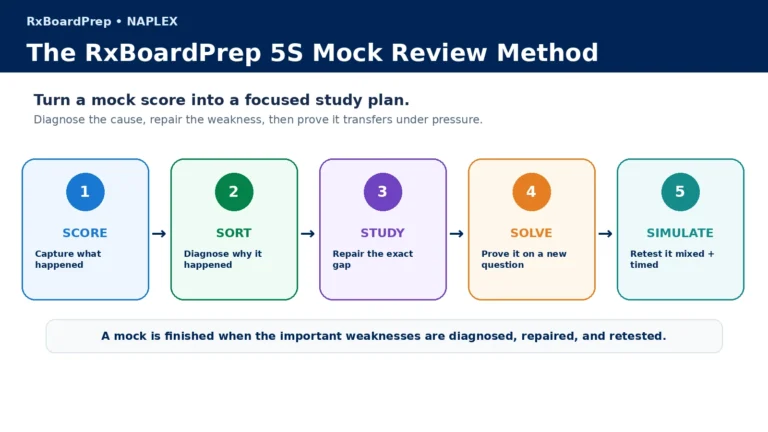
Mistake 3: Measuring readiness only by total percentage. A single overall score can hide a serious weakness. Review missed questions by both domain and error type: knowledge gap, calculation setup, missed clue, prioritization, distractor selection, or time pressure.
Test the blueprint under exam-style conditions
Reading the content outline shows what may be assessed. A mixed practice exam shows whether you can recognize and apply those areas under time pressure.
Start here: Free RxBoardPrep NAPLEX Mock Exam 1 and review every missed question by domain and reason for the error.
You can also view all free practice exams, explore the RxBoardPrep NAPLEX preparation program, or compare course options and pricing.
Frequently asked questions
Is there a new NAPLEX blueprint for 2026?
The current NAPLEX Content Outline took effect for examinations beginning May 1, 2025 and remains the applicable framework for candidates testing in 2026.
Which NAPLEX domain is the largest?
Person-Centered Assessment and Treatment Planning is the largest domain at approximately 40% of scored questions, or about 80 of the approximately 200 scored questions.
Are calculations a separate NAPLEX domain?
Calculations are included within Foundational Knowledge for Pharmacy Practice. The official outline includes patient parameters, quantities, administration rates, dose conversions, concentrations, compounding quantities, nutrition, biostatistical measures, and pharmacokinetic parameters.
Should I study strictly according to the percentages?
Use the percentages as a baseline, then increase time for demonstrated weaknesses. Continue practicing the largest domain and recurring skills every week rather than studying one domain once and leaving it behind.
Can student reports predict what will be on my NAPLEX?
No. Student reports are most useful for identifying repeated preparation challenges such as breadth, calculations, case interpretation, neglected professional topics, and pacing. They cannot predict exact questions or guarantee a topic distribution.
Final takeaway
The five-domain outline should change how you organize preparation. Do not treat the NAPLEX as a collection of disconnected therapeutic chapters. Build the ability to calculate, verify, select, monitor, counsel, document, report, and improve medication use as an entry-level pharmacist.
Broad coverage protects you from surprises. Repeated skill practice builds speed. Timed mixed cases reveal whether you can apply what you know when the topic is not announced for you.
Ready for Your Next Step?
Sources and methodology
National Association of Boards of Pharmacy. NAPLEX Content Outline. Effective for all NAPLEX examinations beginning May 1, 2025. Official PDF
National Association of Boards of Pharmacy. NAPLEX Test Day Information. Official page
RxBoardPrep. NAPLEX 2026 Student Insights & Course Blueprint. Internal synthesis of more than 130 student-reported exam experiences collected January–June 2026.
RxBoardPrep is an independent pharmacy education platform and is not affiliated with or endorsed by NABP. NAPLEX is a registered trademark of the National Association of Boards of Pharmacy.