2026 FPGEE Content Outline Explained: Four Domains and Study Priorities
The FPGEE is not simply a pharmacology examination. It evaluates whether a foreign pharmacy graduate’s education is comparable to the knowledge base developed through a United States pharmacy curriculum. That is why the current content outline reaches from biomedical sciences and pharmaceutics to health care systems, professional communication, clinical decision-making, and evidence-based practice.
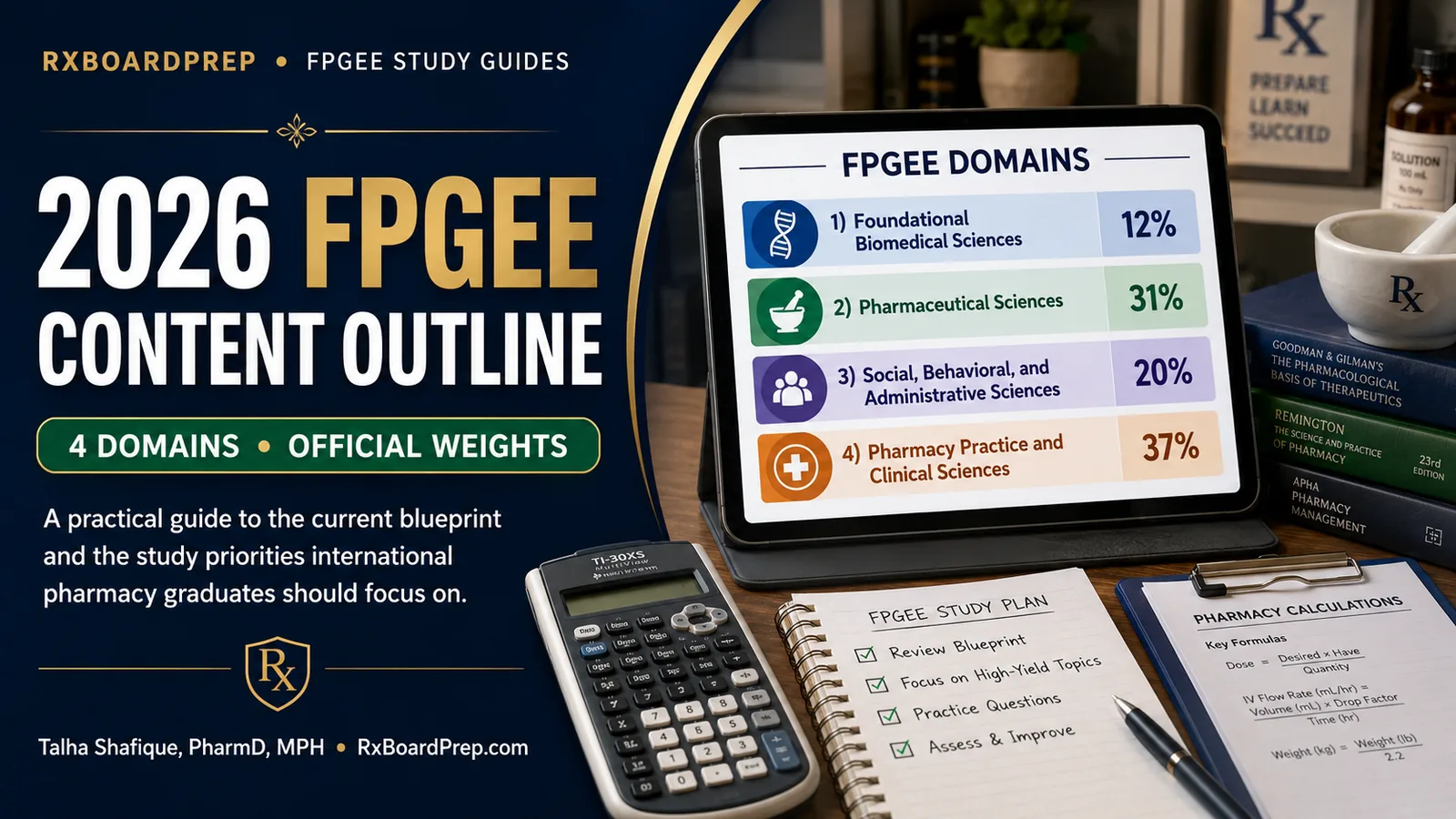
For candidates preparing in 2026, the most useful first step is to stop treating the syllabus as one enormous list of unrelated chapters. The official FPGEE Content Outline organizes the examination into four domains with different weights. Those weights show where the greatest share of scored questions comes from—but they also show why skipping smaller subjects can be costly.
Official exam snapshot for 2026: The FPGEE contains 200 questions, provides 4.5 hours of examination time within a 5.5-hour total seat time, and requires a scaled score of 75 to pass. NABP has scheduled the 2026 administration for October 15, 2026.
The four FPGEE domains at a glance
| Official domain | Exam weight | Approximate scored questions |
|---|---|---|
| Foundational Biomedical Sciences | 12% | 24 |
| Pharmaceutical Sciences | 31% | 62 |
| Social, Behavioral, and Administrative Sciences | 20% | 40 |
| Pharmacy Practice and Clinical Sciences | 37% | 74 |
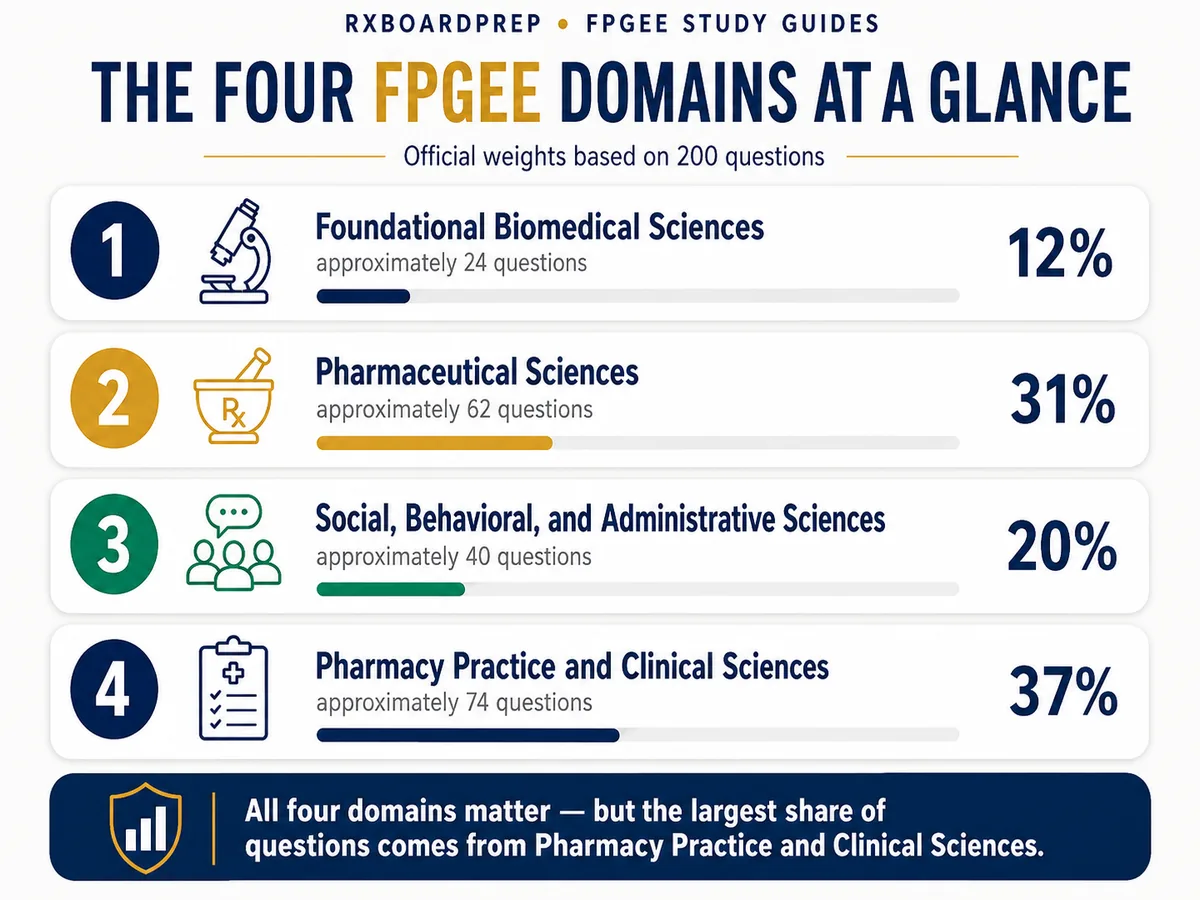
The first major lesson is easy to miss: Domains 2 and 4 together account for approximately 68% of the examination. Pharmaceutical sciences and clinical pharmacy therefore deserve the largest share of study time. However, the remaining 32% still represents about 64 scored questions. A candidate who ignores biomedical foundations or social and administrative sciences gives away too many possible points.
Domain 1: Foundational Biomedical Sciences — 12%
This domain covers the biological basis needed to understand disease and drug action. Its official subdomains include:
- Anatomy and physiology
- Biochemistry
- Medical microbiology
- Immunology
- Pathophysiological bases of disease
At 12%, this is the smallest domain, but it supports nearly everything that follows. Physiology helps you understand clinical monitoring. Biochemistry explains metabolism, enzyme function, and cellular signaling. Microbiology and immunology support infectious diseases, vaccines, and biologic therapies. Pathophysiology helps you understand why a treatment fits one disease state but not another.
How to study Domain 1 efficiently
Do not prepare it as a stand-alone basic-science course filled with isolated facts. Connect every concept to pharmacy:
- Link organ physiology to drug effects and monitoring.
- Link microbial characteristics to antimicrobial selection.
- Link immunology to vaccines, autoimmune conditions, and biologics.
- Link pathophysiology to signs, symptoms, laboratory findings, and therapeutic goals.
The goal is not to memorize every detail from a medical textbook. The goal is to understand the biological reasoning that supports pharmaceutical and clinical decisions.
Domain 2: Pharmaceutical Sciences — 31%
Domain 2 is the largest science-focused section and represents approximately 62 scored questions. It includes much more than mechanisms of action.
The official outline includes:
- Pharmaceutical calculations
- Medicinal chemistry
- Pharmacology and toxicology
- Pharmaceutics and biopharmaceutics
- Pharmacokinetics
- Pharmacogenomics
- Extemporaneous compounding, including USP-related sterile and nonsterile preparation concepts
This domain tests whether you understand how a drug is designed, formulated, delivered, absorbed, distributed, metabolized, eliminated, and used safely.
What candidates often underestimate in Domain 2
Many students devote most of their time to pharmacology while giving limited attention to the other pharmaceutical sciences. That creates an uneven foundation. The outline explicitly includes areas such as:
- Dosage-form design and drug-delivery systems
- Disintegration and dissolution
- Physical and chemical stability
- Zero-, first-, second-, and pseudo-order reactions
- Bioavailability, bioequivalence, and biosimilars
- Structure-activity relationships
- Drug metabolism pathways
- Toxic exposures, overdoses, and antidotes
- Pharmacogenetic screening
- Sterile and nonsterile compounding standards and techniques
A strong Domain 2 plan should rotate among calculations, pharmacology, pharmaceutics, pharmacokinetics, medicinal chemistry, and compounding rather than completing one subject once and never revisiting it.
A practical Domain 2 study pattern
Use three levels of learning:
- Know the principle: Understand the formula, mechanism, kinetic concept, or formulation principle.
- Recognize the application: Identify how that principle changes absorption, dosing, toxicity, stability, or product selection.
- Solve or apply it: Complete a calculation, interpret a graph, compare formulations, or select the safest response.
That structure prevents the common problem of recognizing a term without being able to use it in a question.
Domain 3: Social, Behavioral, and Administrative Sciences — 20%
Domain 3 accounts for approximately 40 scored questions. It is one of the most underestimated parts of FPGEE preparation because it does not resemble traditional pharmacology or therapeutics.
The official outline includes:
- Pharmacy law and ethics
- United States health care systems
- Pharmacoeconomics
- Population-based care, pharmacoepidemiology, and public health
- Practice management
- Professional communication and health literacy
- Biostatistics and research methods
- Social and behavioral aspects of pharmacy practice
This domain requires familiarity with how pharmacy operates within the United States health care environment. It also tests how pharmacists communicate, interpret evidence, improve quality, manage resources, and respond to patient behavior and cultural factors.
Why Domain 3 deserves dedicated preparation
International pharmacy graduates may have strong scientific and clinical backgrounds but less exposure to the organization and financing of United States health care. The outline specifically includes:
- Health care delivery and financing
- Social, political, economic, and technological influences on care
- Financial management and budgeting
- Personnel management
- Procurement and inventory control
- Risk management
- Continuous quality improvement
- Social determinants and drivers of health
- Health literacy
- Patient adherence and behavior modification
- Study designs, statistical tests, and research ethics
These topics should not be left for the final week. They require vocabulary, conceptual understanding, and repeated question practice.
A better way to organize Domain 3
Break it into four practical clusters:
- Systems and management: health care delivery, financing, budgeting, personnel, inventory, and risk
- Evidence and population health: biostatistics, study design, pharmacoepidemiology, public health, and quality improvement
- Law and ethics: professional obligations, regulation, oversight, and ethical reasoning
- Communication and behavior: health literacy, adherence, cultural awareness, patient behavior, and professional communication
This makes the domain easier to review than treating it as one large collection of miscellaneous chapters.
Domain 4: Pharmacy Practice and Clinical Sciences — 37%
At approximately 74 scored questions, Domain 4 is the largest domain on the FPGEE. It evaluates how well you collect information, interpret patient data, make treatment decisions, monitor outcomes, and protect patients from harm.
The official outline includes:
- Clinical pathophysiology
- Patient-history and data collection
- Physical assessment, laboratory values, and point-of-care testing
- Data assessment and clinical calculations
- Patient-care decision-making and therapy recommendations
- Monitoring and follow-up
- Patient safety
- Disease prevention and immunization
- Personalized medicine
- Evidence-based practice
- Self-care and natural products
This is not simply a list of disease-state treatment guidelines. Questions can require you to combine the disease, medication list, laboratory findings, contraindications, interactions, monitoring needs, and patient-specific factors.
How to approach Domain 4 questions
Use a repeatable clinical sequence:
- Identify the active problem or therapeutic goal.
- Review allergies, contraindications, pregnancy status, organ function, and important laboratory values.
- Decide whether the current therapy is indicated, effective, safe, and practical.
- Compare the answer choices using patient-specific factors.
- Select the best recommendation, monitoring plan, counseling point, or follow-up action.
This method is more reliable than searching the case for one memorized keyword.
Do not overlook self-care and evidence evaluation
The outline places self-care, natural products, information-source reliability, practice guidelines, drug information, and clinical-trial evaluation inside Domain 4. Candidates who study only prescription therapeutics may leave several important areas uncovered.
How to convert the outline into a study plan
The official percentages should guide your time, but they should not become rigid limits. A weaker domain may need more time than its exam weight suggests.
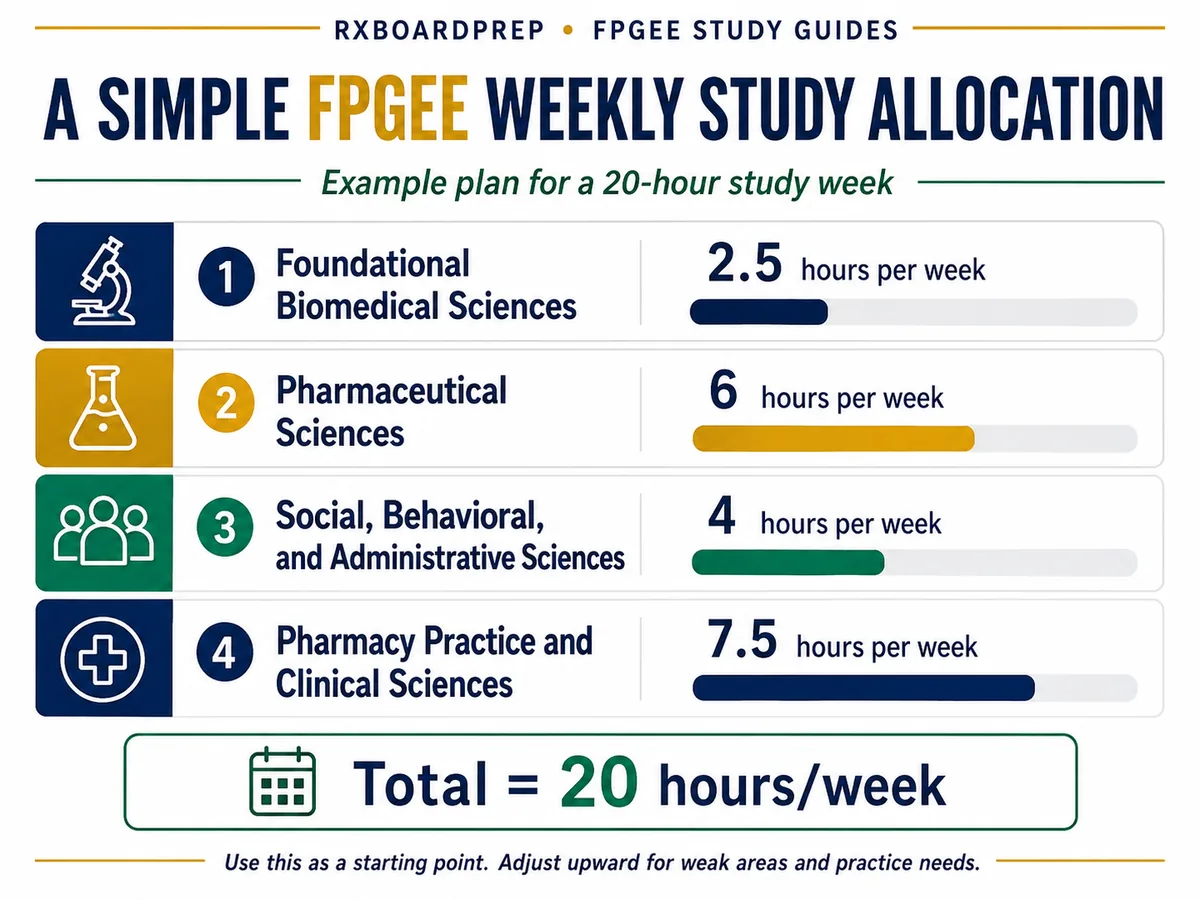
A reasonable starting allocation for 20 weekly study hours is:
| Study block | Suggested weekly time |
|---|---|
| Pharmacy Practice and Clinical Sciences | 7–8 hours |
| Pharmaceutical Sciences | 6–7 hours |
| Social, Behavioral, and Administrative Sciences | 3–4 hours |
| Foundational Biomedical Sciences | 2–3 hours |
This is an RxBoardPrep planning model, not an official NABP requirement. Adjust it according to your baseline performance.
Add three activities every week
Regardless of the domain being studied, include:
- Cumulative review: Revisit older material so it does not disappear when you move to a new chapter.
- Mixed questions: Practice switching between science, calculations, clinical cases, and administrative topics.
- Error analysis: Record why you missed each question—knowledge gap, calculation error, misreading, weak application, or confusion between similar options.
That combination is more effective than reading each subject once in isolation.
Four mistakes to avoid
1. Studying only pharmacology and therapeutics
Those subjects are essential, but the official outline also gives substantial weight to pharmaceutics, pharmacokinetics, calculations, biostatistics, health systems, management, communication, and public health.
2. Treating the 12% domain as unimportant
Twenty-four questions are enough to materially affect the result. Biomedical sciences also support performance in the pharmaceutical and clinical domains.
3. Leaving Domain 3 until the end
Social, behavioral, and administrative sciences represent one-fifth of the examination. They need structured study, not a last-minute skim.
4. Studying every topic with equal intensity
Complete coverage is necessary, but equal time is not. Use the official weights, your question performance, and your weak areas to decide where deeper practice is needed.
Test your starting point before building your schedule
A practice exam can show whether your current weakness is scientific knowledge, calculations, clinical application, or administrative concepts.
RxBoardPrep offers two free FPGEE practice sets:
- Set A — High-Yield Mix: calculations, pharmacology, pharmacokinetics, biostatistics, immunizations, and pharmacy law
- Set B — Tougher Reasoning: multi-step calculations, drug interactions, and clinical judgment
Try the free FPGEE practice exams
After reviewing your results, use the four official domains to organize the topics you missed. That creates a study plan based on evidence rather than guesswork.
Final takeaway
The current FPGEE Content Outline provides a clear message: success requires breadth across pharmacy education, not mastery of only one subject area.
- Domain 1 supplies the biomedical foundation.
- Domain 2 explains drugs, formulations, kinetics, calculations, and compounding.
- Domain 3 covers the systems, evidence, behavior, communication, management, law, and public-health environment of pharmacy.
- Domain 4 brings those areas together in patient care and clinical decision-making.
Use the weights to prioritize your effort, but keep all four domains in your plan. The strongest preparation is both complete enough to avoid major gaps and weighted enough to spend the most time where the examination places the greatest emphasis.
Ready for a guided FPGEE plan?
The RxBoardPrep FPGEE program includes live cohort classes, recorded sessions, comprehensive notes, original practice questions, realistic timed exams, study schedules, and direct instructor support.
Frequently Asked Questions
How many domains are in the current FPGEE Content Outline?
There are four official domains: Foundational Biomedical Sciences; Pharmaceutical Sciences; Social, Behavioral, and Administrative Sciences; and Pharmacy Practice and Clinical Sciences.
Which FPGEE domain has the greatest weight?
Pharmacy Practice and Clinical Sciences has the greatest weight at 37%, representing approximately 74 of the 200 scored questions.
How much of the FPGEE is pharmaceutical science?
Pharmaceutical Sciences accounts for approximately 31% of the examination, or about 62 scored questions.
Is pharmacy management tested on the FPGEE?
Yes. Practice management appears within Domain 3 and includes financial management, personnel management, business planning, risk management, and procurement and inventory control.
Are biostatistics and research methods part of the FPGEE?
Yes. Biostatistics and research methods are explicitly included within Social, Behavioral, and Administrative Sciences. Evidence-based practice and clinical-trial evaluation also appear within Pharmacy Practice and Clinical Sciences.
Does the FPGEE test compounding?
Yes. Extemporaneous compounding is included in Pharmaceutical Sciences, including sterile and nonsterile preparation concepts, calculations, techniques, and relevant USP standards.
Should study time exactly match the official domain percentages?
The percentages are a strong starting point, but study time should also reflect personal weaknesses. A candidate who performs poorly in a smaller domain may need to spend more time there than the official weight alone suggests.
Official Sources
- National Association of Boards of Pharmacy. Foreign Pharmacy Graduate Equivalency Examination (FPGEE) Content Outline.
- National Association of Boards of Pharmacy. FPGEE Exam Information, Registration, Preparation, and 2026 Dates.
- National Association of Boards of Pharmacy. Pre-FPGEE Practice Exam.