
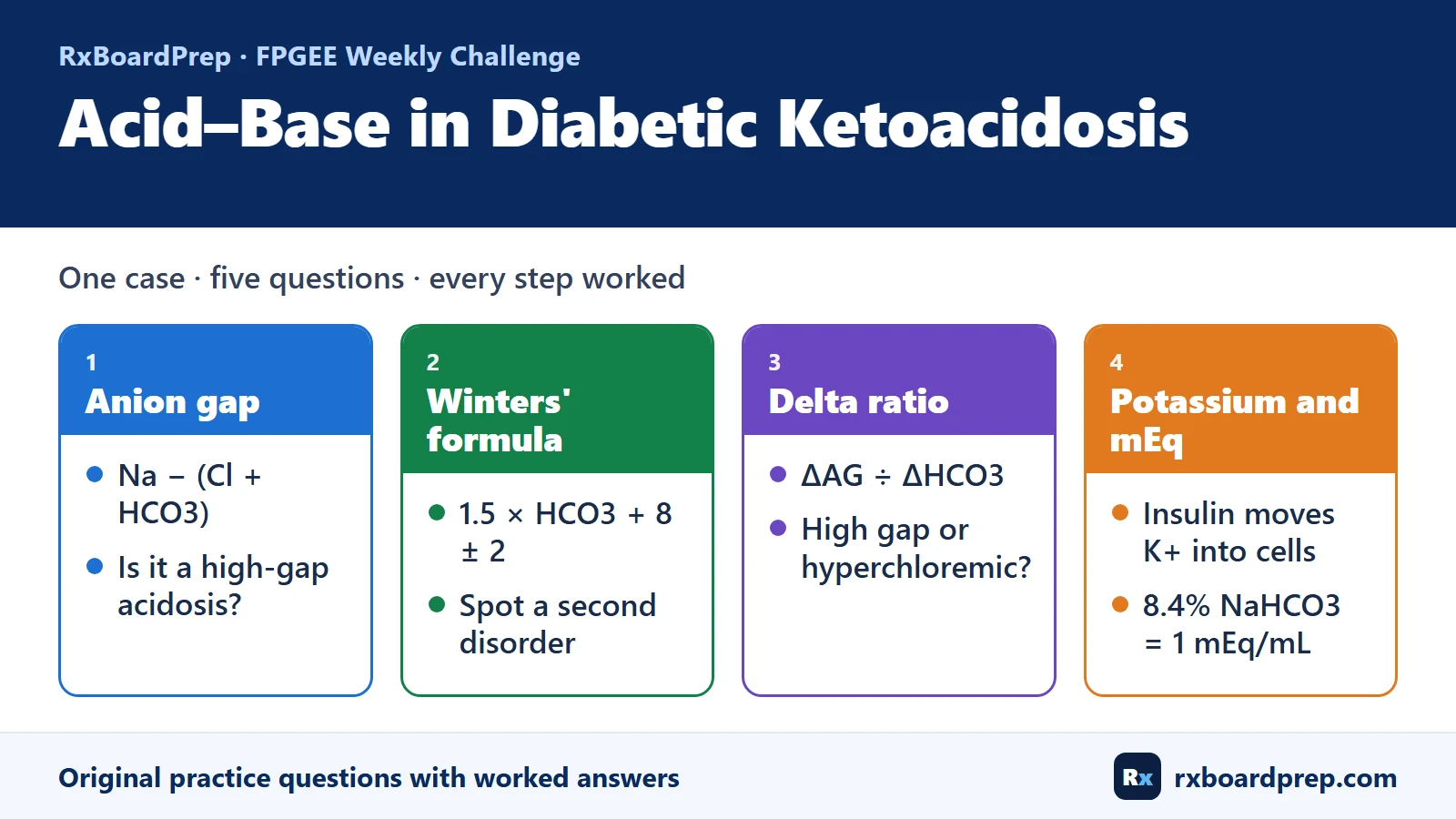
FPGEE Weekly Challenge: Acid–Base in Diabetic Ketoacidosis
Acid-base questions reward a fixed routine more than memory. This week’s Foreign Pharmacy Graduate Equivalency Examination (FPGEE) challenge follows one patient with diabetic ketoacidosis (DKA) from admission to day 2. Over five questions you will name the primary disorder, check whether breathing is compensating as expected, spot a second disorder as treatment goes on, explain why potassium falls once insulin starts, and finish with a pharmaceutical calculation.
The physiology here belongs to Domain 1 of the National Association of Boards of Pharmacy (NABP) FPGEE Content Outline (Foundational Biomedical Sciences: anatomy and physiology, and the pathophysiological bases of disease). The calculation belongs to Domain 2.A (pharmaceutical calculations). For the full outline, see our FPGEE content outline guide.
Try every question before you read the answers. Write down your letter and one line of working for each.
Case
A 24-year-old woman with type 1 diabetes has vomiting and abdominal pain after missing several insulin doses. She weighs 60 kg.
Admission results (arterial blood gas and serum chemistry):
| Test | Result |
|---|---|
| Glucose | 486 mg/dL |
| Sodium | 136 mEq/L (milliequivalents per liter) |
| Chloride | 98 mEq/L |
| Bicarbonate (HCO3) | 12 mEq/L |
| Potassium | 5.4 mEq/L |
| Albumin | 4.0 g/dL |
| Arterial pH | 7.29 |
| PaCO2 (arterial partial pressure of carbon dioxide) | 26 mm Hg |
| Serum beta-hydroxybutyrate | 6.2 mmol/L |
About 6 hours into treatment: she is drowsier and her breathing is shallower. A repeat arterial blood gas shows pH 7.21, PaCO2 36 mm Hg and bicarbonate 14 mEq/L.
Day 2: after several liters of 0.9% sodium chloride and an insulin infusion, her beta-hydroxybutyrate is falling. Results: sodium 141 mEq/L, chloride 112 mEq/L, bicarbonate 16 mEq/L, arterial pH 7.34 and PaCO2 31 mm Hg.
Unless a question says otherwise, use a normal anion gap of 12 mEq/L and a normal bicarbonate of 24 mEq/L. The anion gap here is calculated without potassium.
Questions
Question 1
A 24-year-old woman with type 1 diabetes has vomiting and abdominal pain after missing several insulin doses. Results: glucose 486 mg/dL; sodium 136 mEq/L; chloride 98 mEq/L; bicarbonate 12 mEq/L; arterial pH 7.29; PaCO2 26 mm Hg; serum beta-hydroxybutyrate 6.2 mmol/L. Which interpretation is correct?
- A. Anion-gap metabolic acidosis with appropriate respiratory compensation
- B. Anion-gap metabolic acidosis with a coexisting respiratory acidosis
- C. Normal-anion-gap (hyperchloremic) metabolic acidosis
- D. Primary respiratory alkalosis with metabolic compensation
Question 2
About 6 hours into treatment, she is drowsier and her breathing is shallower. Repeat arterial blood gas: pH 7.21, PaCO2 36 mm Hg, bicarbonate 14 mEq/L. Using Winters’ formula, which interpretation is correct?
- A. Expected PaCO2 is 27 to 31 mm Hg, so the measured 36 mm Hg shows a coexisting respiratory acidosis.
- B. Expected PaCO2 is 27 to 31 mm Hg, so the measured 36 mm Hg shows a coexisting respiratory alkalosis.
- C. A normal PaCO2 is 40 mm Hg, so a PaCO2 of 36 mm Hg shows that respiratory compensation is still appropriate.
- D. Because the pH has fallen, the primary disorder is now a respiratory acidosis with metabolic compensation.
Question 3
On day 2: sodium 141 mEq/L, chloride 112 mEq/L, bicarbonate 16 mEq/L, pH 7.34, PaCO2 31 mm Hg. Using a normal anion gap of 12 mEq/L and a normal bicarbonate of 24 mEq/L, what is the delta ratio (change in anion gap divided by change in bicarbonate), and what does it suggest?
- A. 1.17; a pure anion-gap metabolic acidosis, unchanged from admission
- B. 0.125; the remaining acidosis is mainly a normal-anion-gap (hyperchloremic) metabolic acidosis
- C. 2.5; an anion-gap metabolic acidosis with a coexisting metabolic alkalosis
- D. 8; a worsening anion-gap metabolic acidosis from ongoing ketoacid production
Question 4
Her admission potassium is 5.4 mEq/L. Once an insulin infusion starts, what happens to her serum potassium, and why?
- A. It falls, because insulin stimulates the sodium-potassium pump (Na+/K+-ATPase) and moves potassium into cells, while her total-body potassium is actually depleted.
- B. It rises, because correcting the acidosis moves potassium out of cells in exchange for hydrogen ions.
- C. It does not change, because a potassium of 5.4 mEq/L reflects a total-body potassium excess that only the kidneys can remove.
- D. It falls only because intravenous fluids dilute the blood; insulin has no effect on where potassium is distributed.
Question 5
The team discusses, but does not order, intravenous sodium bicarbonate. The pharmacy stocks 8.4% (w/v) sodium bicarbonate injection in 50-mL single-dose vials. Using a molecular weight of 84 g/mol for sodium bicarbonate (NaHCO3), how many milliequivalents (mEq) of bicarbonate does one vial contain?
- A. 4.2 mEq
- B. 25 mEq
- C. 50 mEq
- D. 100 mEq
Answers and explanations
Answer 1: A. Anion-gap metabolic acidosis with appropriate respiratory compensation
Step 1, primary disorder. The pH of 7.29 is acidemic and the bicarbonate is low, so this is a metabolic acidosis.
Step 2, anion gap.
- Formula: anion gap = sodium − (chloride + bicarbonate)
- Substitution: 136 − (98 + 12)
- Calculation: 136 − 110 = 26 mEq/L
- Interpretation: elevated (normally about 8 to 12 mEq/L), consistent with ketoacids in DKA. Albumin is normal, so no albumin correction is needed.
Step 3, expected compensation (Winters’ formula).
- Formula: expected PaCO2 = (1.5 × HCO3) + 8 ± 2
- Substitution: (1.5 × 12) + 8 ± 2
- Calculation: 18 + 8 = 26 ± 2, so 24 to 28 mm Hg
- Interpretation: the measured PaCO2 of 26 mm Hg is within range, so respiratory compensation is appropriate and there is no second respiratory disorder.
Check (Henderson-Hasselbalch): pH = 6.1 + log[HCO3 ÷ (0.03 × PaCO2)] = 6.1 + log[12 ÷ (0.03 × 26)] = 6.1 + log(15.4) = 7.29. The values are internally consistent.
Why the others are wrong:
- B would need a measured PaCO2 above 28 mm Hg.
- C is ruled out by the high anion gap.
- D is ruled out by the acidemic pH.
Practice point: the 2024 American Diabetes Association (ADA) consensus report diagnoses DKA from diabetes (glucose 200 mg/dL or higher, or a known history of diabetes, so DKA can occur with near-normal glucose), ketones (beta-hydroxybutyrate 3.0 mmol/L or higher) and metabolic acidosis, and does not recommend the anion gap as a first-line diagnostic criterion. It still treats an anion gap above 12 as consistent with DKA. Her beta-hydroxybutyrate of 6.2 mmol/L meets the ketone criterion, with glucose 486 mg/dL and a metabolic acidosis.
Answer 2: A. Expected PaCO2 is 27 to 31 mm Hg; the measured 36 mm Hg shows a coexisting respiratory acidosis
- Formula: expected PaCO2 = (1.5 × HCO3) + 8 ± 2
- Substitution: (1.5 × 14) + 8 ± 2
- Calculation: 21 + 8 = 29 ± 2, so 27 to 31 mm Hg
- Interpretation: the measured PaCO2 of 36 mm Hg is above the expected range. She is not breathing off as much carbon dioxide as her metabolic acidosis requires, so a respiratory acidosis now coexists with the metabolic acidosis.
Check: pH = 6.1 + log[14 ÷ (0.03 × 36)] = 6.1 + log(12.96) = 7.21, which matches the reported pH. That is why the pH fell even though the bicarbonate rose slightly from 12 to 14 mEq/L.
Why it matters: in a patient with metabolic acidosis, a PaCO2 that is “normal-looking” can still be too high. Hypoventilation from any cause, such as respiratory muscle fatigue or a sedating medicine, removes the compensation the patient depends on. On an exam, that is the signal for a second, respiratory disorder; in practice, it needs prompt clinical assessment.
Why the others are wrong:
- B: a respiratory alkalosis would push the PaCO2 below 27 mm Hg, not above 31.
- C: compensation is judged against the expected PaCO2 for this bicarbonate, not against the normal value of 40 mm Hg.
- D: the bicarbonate is still low (14 mEq/L), so the metabolic acidosis remains the primary disorder. A primary respiratory acidosis with metabolic compensation would show a raised bicarbonate.
Answer 3: B. 0.125; the remaining acidosis is mainly a normal-anion-gap (hyperchloremic) metabolic acidosis
Step 1, anion gap on day 2.
- Formula: anion gap = sodium − (chloride + bicarbonate)
- Substitution: 141 − (112 + 16)
- Calculation: 141 − 128 = 13 mEq/L, close to normal
Step 2, delta ratio.
- Formula: delta ratio = (measured anion gap − 12) ÷ (24 − measured bicarbonate)
- Substitution: (13 − 12) ÷ (24 − 16)
- Calculation: 1 ÷ 8 = 0.125
Step 3, interpret. With commonly taught cut-offs (they vary slightly between references):
| Delta ratio | Usual interpretation |
|---|---|
| Below 0.4 | Normal-anion-gap (hyperchloremic) acidosis |
| 0.4 to 0.8 | Mixed high-gap and normal-gap acidosis |
| 0.8 to 2 | Pure high-anion-gap acidosis |
| Above 2 | High-gap acidosis plus a metabolic alkalosis (or a pre-existing compensated respiratory acidosis) |
A ratio of 0.125 means the bicarbonate is still low but the anion gap has almost closed: the ketoacid anions are being cleared, and chloride has taken their place. The 2024 ADA consensus report notes that a hyperchloremic normal-anion-gap acidosis is commonly seen after successful DKA treatment and can follow large volumes of 0.9% sodium chloride; it describes it as self-limiting.
Compare with admission: (26 − 12) ÷ (24 − 12) = 14 ÷ 12 = 1.17, a pure high-anion-gap acidosis. The same patient moved from one pattern to another as she was treated.
Check: Winters’ formula for a bicarbonate of 16 gives 32 ± 2 (30 to 34 mm Hg). Her PaCO2 of 31 mm Hg is appropriate, and 6.1 + log[16 ÷ (0.03 × 31)] = 7.34 matches the reported pH.
Why the others are wrong:
- A is the admission value; it ignores the day-2 results.
- C would need the anion gap to rise far more than the bicarbonate fell.
- D inverts the ratio (8 ÷ 1). A near-normal anion gap does not suggest ongoing ketoacid production.
Caution: the delta ratio is a screening aid, not a diagnosis. Its range in real patients is wide, so read it together with the history and the other results.
Answer 4: A. It falls, because insulin moves potassium into cells, while total-body potassium is actually depleted
The physiology. Insulin is one of the main regulators of where potassium sits between the cells and the extracellular fluid. It stimulates the Na+/K+-ATPase, which pumps potassium into cells. In DKA, insulin deficiency and acidosis shift potassium out of cells, so the serum level can be normal or high even though the body has lost potassium through osmotic diuresis, vomiting and high aldosterone activity.
How large is the deficit? The 2024 ADA consensus report estimates a total-body potassium depletion of about 3 to 6 mmol/kg.
- Substitution: 3 to 6 mmol/kg × 60 kg
- Calculation: about 180 to 360 mmol for this patient
What happens with treatment. The ADA report lists insulin therapy, correction of acidosis, volume expansion and increased urinary potassium loss as the factors that lower serum potassium. Its practice rules follow from this:
- If potassium is below 3.5 mmol/L, replace potassium and delay insulin until potassium is above 3.5.
- Start potassium replacement once serum potassium falls below 5.0 mmol/L, usually 20 to 30 mmol per liter of intravenous fluid, to keep potassium at 4 to 5 mmol/L.
(For potassium, 1 mmol equals 1 mEq.)
Why the others are wrong:
- B reverses the direction. As acidosis corrects, hydrogen ions leave cells and potassium moves into cells, so serum potassium falls.
- C: a serum value of 5.4 mEq/L hides a total-body deficit, not an excess.
- D: dilution and volume expansion contribute, but insulin itself shifts potassium into cells. Ignoring that is how dangerous hypokalemia is missed.
Answer 5: C. 50 mEq
- Formula: mEq = (mg × valence) ÷ molecular weight
- Step 1, find the mass: 8.4% w/v means 8.4 g per 100 mL, so 50 mL contains 8.4 × 50 ÷ 100 = 4.2 g = 4,200 mg
- Step 2, substitute: mEq = (4,200 × 1) ÷ 84
- Step 3, calculate: 50 mEq of bicarbonate (and 50 mEq of sodium)
Check: the US labeling for 8.4% sodium bicarbonate injection states 1 mEq per mL, so a 50-mL vial contains 50 mEq. A 1-mEq-per-mL concentration is a useful anchor to remember.
Why the others are wrong:
- A (4.2) is the number of grams, not milliequivalents.
- B (25) halves the answer, for example by treating 4.2 g as the content of 100 mL and then taking half of it for the 50-mL vial.
- D (100) adds the sodium and bicarbonate ions together. Each ion is counted separately: 50 mEq of each.
Practice point: this is a calculation exercise, not a treatment recommendation. The 2024 ADA consensus report does not recommend routine bicarbonate in DKA and advises considering it only if the acidosis is severe (pH below 7.0). With a pH of 7.29 on admission, this patient does not meet that threshold.
High-yield takeaways
- Use three steps for every acid-base question: primary disorder, anion gap, then expected compensation. Never skip step three.
- Winters’ formula: expected PaCO2 = (1.5 × HCO3) + 8 ± 2. A measured PaCO2 above the range means a coexisting respiratory acidosis; below the range means a coexisting respiratory alkalosis.
- A “normal” PaCO2 of 40 mm Hg is not normal in a patient with metabolic acidosis.
- The delta ratio compares the rise in anion gap with the fall in bicarbonate. About 0.8 to 2 suggests a pure high-gap acidosis; well below 1 suggests an added normal-gap (hyperchloremic) acidosis.
- During DKA treatment, a high-gap acidosis can turn into a hyperchloremic normal-gap acidosis as ketoanions clear and chloride is given.
- In DKA, serum potassium can be high while total-body potassium is low. Insulin moves potassium into cells, so serum potassium falls once treatment starts.
- 8.4% sodium bicarbonate = 1 mEq/mL. mEq = (mg × valence) ÷ molecular weight.
Exam tips
- Write the three acid-base steps in the margin of your scratch paper before reading the options.
- When a stem gives a second blood gas, recalculate compensation for the new bicarbonate. Expected values move as bicarbonate changes.
- Check internal consistency with Henderson-Hasselbalch when time allows: 6.1 + log[HCO3 ÷ (0.03 × PaCO2)] should land close to the stated pH.
- In mEq questions, decide first whether the question asks for one ion or for the whole salt. Distractors often double or halve the answer.
- For potassium, separate the serum concentration from the total-body store. Exam stems often test that difference.
Keep practicing
Want more questions across all four FPGEE domains? Try the worked sample questions on our Free FPGEE Practice Test page, then the timed free sets linked there. You can also find more FPGEE challenges on our weekly cases page.
Original RxBoardPrep practice material for education; not real exam questions and not medical advice.
References
- National Association of Boards of Pharmacy. Foreign Pharmacy Graduate Equivalency Examination (FPGEE) Content Outline (2025), Domains 1 and 2.A. https://nabp.pharmacy/wp-content/uploads/2025/10/FPGEE-Content-Outline.pdf (accessed 29 October 2026).
- Umpierrez GE, Davis GM, ElSayed NA, et al. Hyperglycemic crises in adults with diabetes: a consensus report. Diabetes Care. 2024;47(8):1257-1275. https://doi.org/10.2337/dci24-0032 ; full text: https://pmc.ncbi.nlm.nih.gov/articles/PMC11272983/ (accessed 29 October 2026).
- Albert MS, Dell RB, Winters RW. Quantitative displacement of acid-base equilibrium in metabolic acidosis. Ann Intern Med. 1967;66(2):312-322. https://doi.org/10.7326/0003-4819-66-2-312 (accessed 29 October 2026).
- Rastegar A. Use of the ΔAG/ΔHCO3− ratio in the diagnosis of mixed acid-base disorders. J Am Soc Nephrol. 2007;18(9):2429-2431. https://doi.org/10.1681/ASN.2006121408 (accessed 29 October 2026).
- Palmer BF, Clegg DJ. Physiology and pathophysiology of potassium homeostasis. Adv Physiol Educ. 2016;40(4):480-490. https://doi.org/10.1152/advan.00121.2016 (accessed 29 October 2026).
- Sodium bicarbonate injection, USP 8.4% (Civica, Inc.) prescribing information, revised 01/2026. DailyMed. https://dailymed.nlm.nih.gov/dailymed/drugInfo.cfm?setid=3737e5e5-2296-4a3d-b8f1-dfea1eff1927 (accessed 29 October 2026).
RxBoardPrep is an independent education provider and is not affiliated with or endorsed by NABP.
How this guide was prepared: drafted with AI assistance from the sources listed above, fact-checked against those sources, with every calculation independently recomputed before publication. Published by RxBoardPrep under the editorial oversight of Talha Shafique, PharmD, MPH.